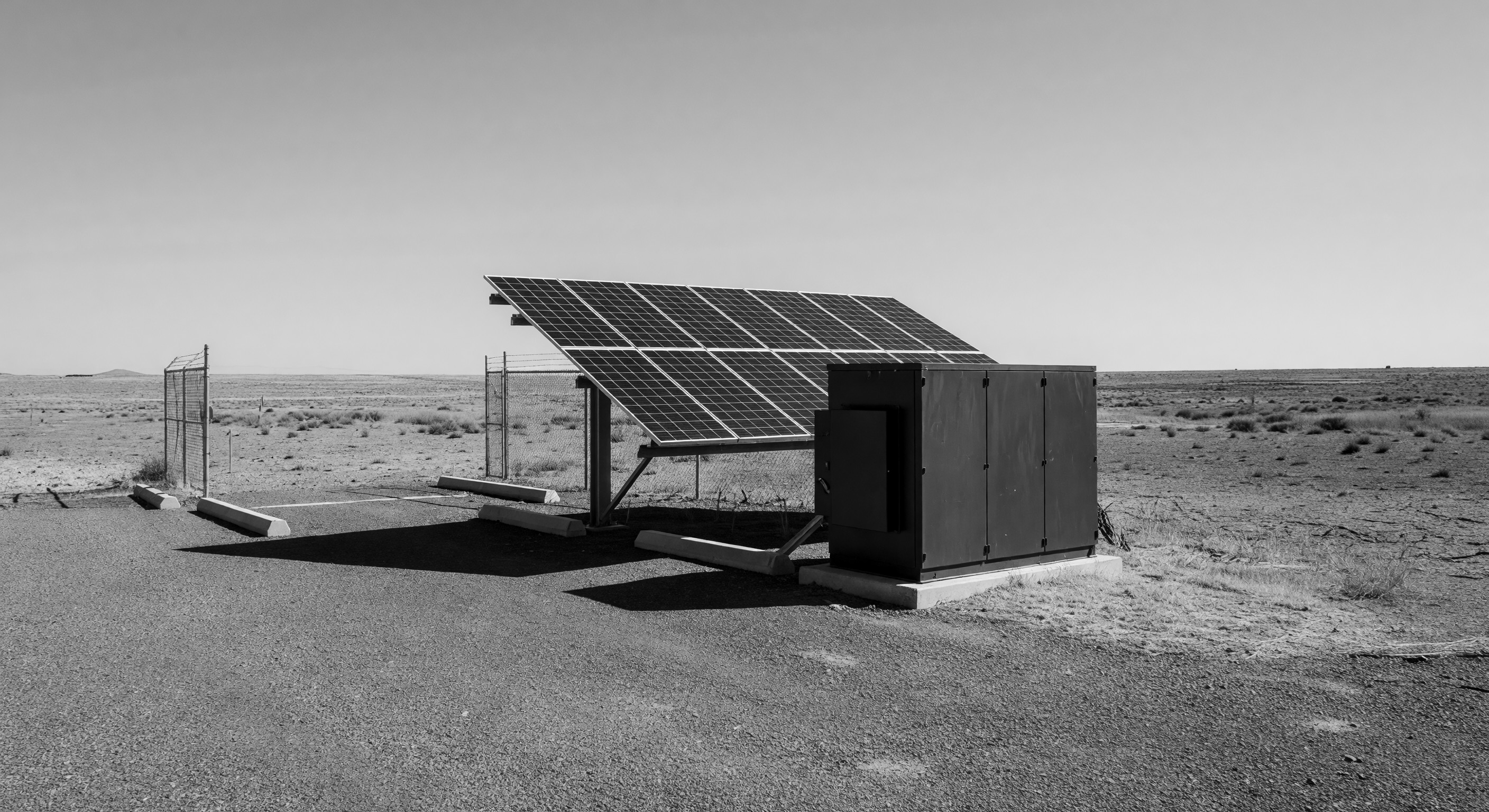
A solar-powered barrier gate is a reasonable solution for a remote trailhead, a rural agricultural access, or a seasonal campground entrance. It is a bad solution for a commercial facility with 500+ cycles per day, a Class 4 duty profile, or a latitude above 45°N with standard panel sizing. The difference between the two applications is the sizing math — and the math is routinely skipped in proposals.
This piece walks through the calculations that separate a solar installation that runs for a decade from one that fails its first February.
Load Characterization
The starting point is the gate’s daily energy consumption. Not the peak draw during a cycle — the total watt-hours over a 24-hour period.
A typical DC barrier gate consumes:
- Active cycle (arm moving): 120-250 W for 3-5 seconds per cycle
- Idle/standby: 5-15 W continuous
- Controller and accessories (reader, loops, status LEDs): 8-20 W continuous
Daily energy for a 200-cycle-per-day installation:
- Cycle energy: 200 cycles × 200 W × 4 sec / 3600 sec/hr = 44 Wh/day
- Idle energy: 10 W × 24 hr = 240 Wh/day
- Accessories: 12 W × 24 hr = 288 Wh/day
- Total: ~572 Wh/day
The idle and accessory loads dominate, not the cycles. Solar-powered gates with LED-lit status displays, always-on cellular modems, and continuously powered readers quickly exceed 1 kWh/day. Every watt of continuous load matters more than every cycle.
Insolation — The Variable That Breaks Bad Designs
Solar insolation varies enormously by latitude and season. Average daily kWh/m²/day values:
| Location | Summer (Jul) | Winter (Jan) |
|---|---|---|
| Phoenix, AZ | 7.5 | 4.2 |
| Atlanta, GA | 6.0 | 3.4 |
| Chicago, IL | 5.8 | 2.0 |
| Seattle, WA | 6.0 | 1.1 |
| Anchorage, AK | 5.5 | 0.4 |
Sizing to the summer value yields a system that fails in winter. Sizing to the annual average yields a system that fails during the worst week. Professional sizing uses the worst-month average and applies an additional 20-30% margin.
NREL (National Renewable Energy Laboratory) publishes PVWatts and the National Solar Radiation Database — these are the authoritative data sources for U.S. installations. Solar contractors who cite “average insolation” without specifying the month are skipping the real constraint.
Panel Sizing
Panel sizing starts from the worst-month daily energy need, derated for system losses:
- Daily load: 572 Wh (from above)
- System losses (wiring, battery charge/discharge inefficiency, controller overhead): ~25%, so divide by 0.75 → 763 Wh/day
- Worst-month insolation (Chicago January, 2.0 peak sun hours): 763 / 2.0 = 381 W of panel
Round up to available panel sizes. A single 400 W panel works for this load in Chicago. The same load in Seattle (1.1 peak sun hours in January) needs 694 W — nearly double. A 200 W panel sized on summer insolation will work from April to October and fail every winter.
Panel tilt angle should approximate the latitude plus 15° for winter optimization. A Chicago site (42°N) should tilt panels at about 57° for winter weighting, not the summer-optimal 27°.
Battery Sizing
Batteries carry the system through cloudy days and diurnal cycles. Sizing factors:
- Autonomy: Days of operation without sun. Three to five days is typical for mid-latitude commercial; seven days for high-latitude or critical applications.
- Depth of discharge (DoD): Lead-acid AGM tolerates 50% DoD for decent cycle life. LiFePO4 tolerates 80-90% DoD. Lead-acid cycled to 80% fails in 200-400 cycles; LiFePO4 cycled to 80% lasts 3,000-5,000 cycles.
- Temperature derating: Battery capacity drops below freezing. Lead-acid at 0°F provides ~60% of its rated capacity; LiFePO4 at 0°F without internal heating provides ~50% and can be damaged by charging at those temperatures.
Sizing calculation for 572 Wh/day load, 5-day autonomy, AGM at 50% DoD:
- Usable capacity needed: 572 × 5 = 2,860 Wh
- Total capacity (accounting for 50% DoD): 5,720 Wh
- At 12 V: 477 Ah battery bank
- Temperature derating for northern climate: divide by 0.7 → 681 Ah
This is a significant battery bank — physically large, expensive, and heavy. LiFePO4 sizing for the same load, 80% DoD, with internal heating for cold climates:
- Usable capacity: 2,860 Wh
- Total capacity: 3,575 Wh
- At 12 V: 298 Ah
LiFePO4 typically wins on total cost of ownership despite higher purchase price, because of cycle life and reduced temperature derating. UL 9540 and UL 1973 cover stationary battery safety; specifying listed batteries is a best practice.
When Solar Doesn’t Work
Honest answers on where solar fails:
- High-cycle commercial (Class 3+): Load grows faster than panel area can reasonably provide. A 1,500-cycle-per-day gate needs utility power or a large solar-plus-generator hybrid.
- Heated cabinet climates above the Arctic Circle or mountain passes: The heater load during winter exceeds reasonable solar production. Propane, fuel-cell, or grid backup is required.
- Dense forest canopy: Site-specific shading more than halves production even with optimal panel orientation. Pole-mounted panels above the canopy line may work; cabinet-mounted panels do not.
- Frequent snow cover: Panels under 8+ inches of snow produce nothing. Manual clearing, steep tilt, or heated panels are needed in heavy-snow regions.
When Solar Works Well
- Remote or rural sites where grid extension costs more than $5,000-$10,000
- Seasonal operations (campgrounds, agricultural entries) where winter operation is not required
- Low-duty applications under 200 cycles per day
- Mid-latitude to low-latitude sites with clear sky exposure
- Installations where environmental or permitting constraints prevent trenching for grid power
Proper design, sized for the worst month, with LiFePO4 batteries and generous panel margin, delivers 10+ years of reliable service at a total cost often lower than grid extension.
FAQ
How many watts of solar panel do I need for a barrier gate?
Depends on daily cycles, idle load, and latitude. A low-duty gate (~200 cycles/day) in mid-latitude needs roughly 400-800 W of panel. High-cycle commercial gates are not good solar candidates. Size to the worst-month insolation value, never the annual average.
Can I run a barrier gate on solar in Canada or the northern U.S.?
For seasonal or low-duty applications, yes. For year-round commercial duty, it becomes expensive and marginal — battery banks and panel arrays grow large. A solar-plus-grid hybrid or grid-only usually wins.
How long will the batteries last?
LiFePO4 batteries, properly sized and temperature-managed, last 8-12 years. AGM lead-acid batteries in solar cycling service last 3-5 years. Flooded lead-acid in a gate enclosure is not recommended — maintenance access is poor and off-gassing is a sealed-cabinet problem.
What happens if the sun doesn’t shine for a week?
A properly sized system with 5-day autonomy covers most cloudy periods. For longer outages, a backup option — small generator, vehicle jump terminals, or temporary grid connection — is worth planning for in critical applications.
Hero image: “Barra autonoma de acceso” by Carbec, CC BY-SA 4.0, via Wikimedia Commons (https://commons.wikimedia.org/wiki/File:Barra_autonoma_de_acceso.jpg).
)