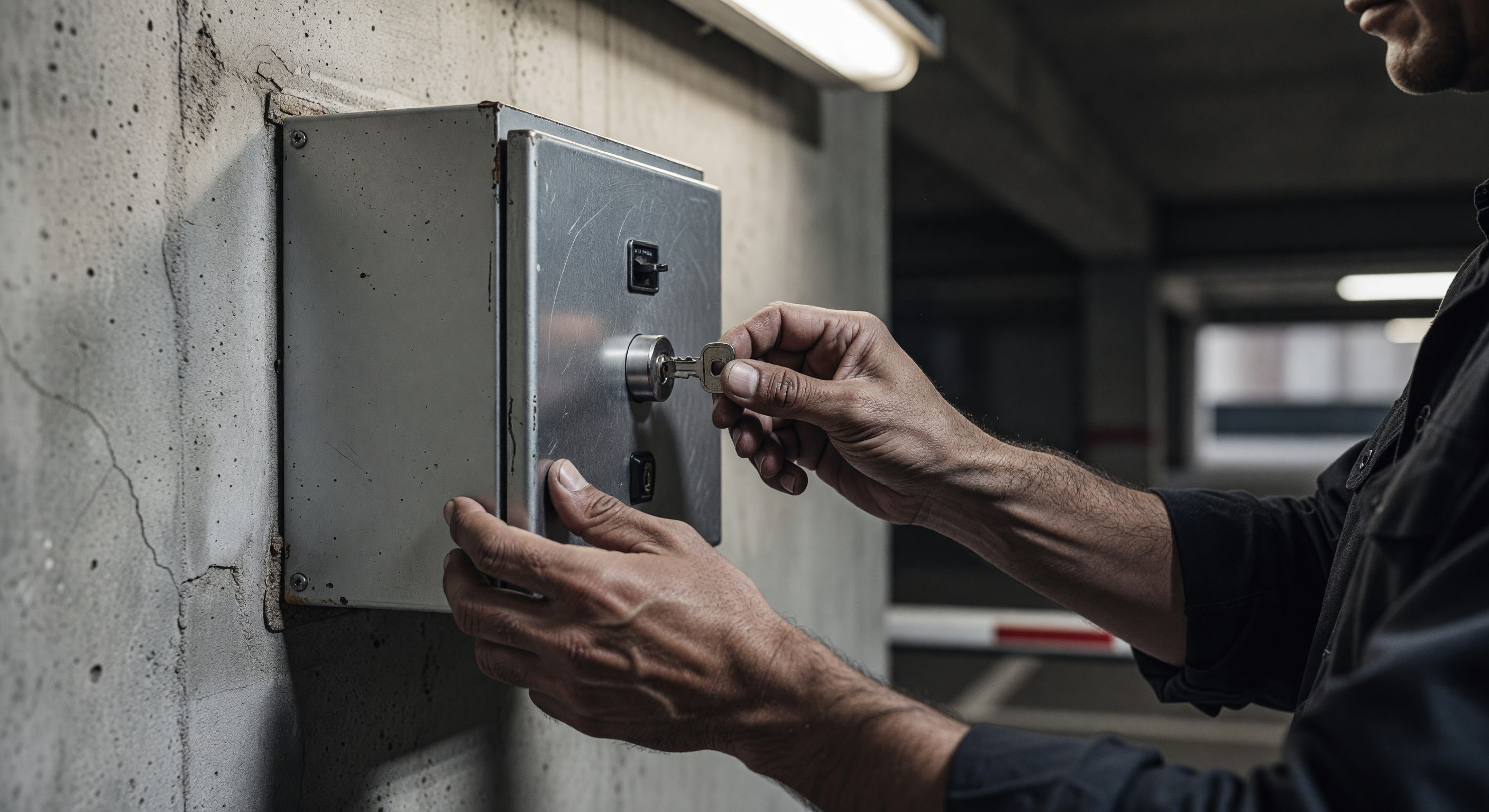
A barrier gate with a dead motor, a controller lockup, or a power loss has to be manually operable. Every commercial gate is designed with at least one override path — usually a key-operated bypass and a separate mechanical clutch disengagement. The problem is that staff rarely practice the procedures, so when the emergency arrives, the override instructions are in a binder no one can find.
This piece covers the override landscape in general terms. Specific procedures vary by operator model — always use the current manufacturer documentation for the installed equipment, not a generic walkthrough.
Override Categories
Electrical bypass (key switch): A physical key switch, usually on the front of the cabinet or a remote keybox, that commands the controller to raise the arm regardless of credential state. Works only when the controller and motor are both functional. Common use: credential reader failure, stuck loop detector, authorized manual operation.
Emergency open input: A hardwired contact closure — typically from a fire alarm panel, emergency exit button, or guard station — that commands the controller to raise and hold the arm. Same requirement as the key switch (controller and motor operational) but triggered by system conditions rather than a person with a key.
Mechanical clutch disengagement: A lever, handle, or release screw inside the gate housing that decouples the motor/gearbox from the arm, allowing the arm to be moved by hand. This is the override that works during power loss, motor failure, or total controller failure.
Removable arm pin: On some gates, the arm attaches to the drive shaft with a pin that can be removed, allowing the arm to be lifted free entirely. Common on industrial gates where full arm removal supports ingress of oversize vehicles.
When Each Override Applies
| Condition | Key switch | Emergency input | Clutch | Remove arm |
|---|---|---|---|---|
| Credential reader failed | Yes | - | - | - |
| Loop detector failed | Yes | - | - | - |
| Power failure | No | No | Yes | Yes |
| Motor or gearbox failure | No | No | Yes | Yes |
| Controller lockup | No | No | Yes | Yes |
| Fire alarm | - | Yes | - | - |
| Need oversize vehicle access | Possibly | - | Yes | Yes |
Fire and Life-Safety Integration
NFPA 101 (Life Safety Code) and NFPA 1 (Fire Code) impose requirements on any barrier that could obstruct emergency egress or fire apparatus access. Specific requirements vary by occupancy and local amendments, but typical rules include:
- Gates on fire-apparatus access roads must have an override accessible to responding fire companies (Knox box keys, siren-activated strobe sensors, or hardwired fire-panel input).
- Fail-safe gates on egress paths are common but not universal — a parking structure exit gate may be fail-secure if a separate egress door is provided.
- Gates serving occupied buildings should drop power to the motor on fire alarm activation when paired with counterweighted arms that rise under gravity, or energize a raise command on powered operators.
IFC (International Fire Code) Section 503 addresses fire-apparatus access roads and gates; check state and local amendments for specific override requirements.
Training Cadence
Override training should be part of every site’s standard operating procedures. Practical cadence:
- New-hire training: Physical walkthrough with trainer, not a video or slide deck. Hands on the key, hands on the clutch lever, with the gate actually disabled and re-enabled. One hour per gate location.
- Quarterly drills: Every shift runs through an override on at least one gate. Rotate which gate each quarter so every installation gets practiced annually.
- Post-maintenance verification: After any service visit, the staff override should be tested. Service technicians sometimes leave key switches in maintenance mode or clutch linkages misadjusted.
- Documentation: Override procedures in a laminated card at each gate, with manufacturer model number, key location, and clutch lever photo. Binders in offices do not help when the emergency is at 2 a.m.
Safety Risks During Manual Override
Manual override is not a license to skip safety. Common mistakes:
- Raising an arm by clutch against a vehicle: The arm can rebound and strike the operator. Confirm no vehicle under the arm before disengaging the clutch on a counterweighted gate.
- Forgetting to re-engage the clutch: After the emergency, the gate has to be restored to normal operation. An unregaged clutch means the next credential presentation produces no motion.
- Leaving the key switch in override: Same result — the gate holds open indefinitely. Log every override activation and verify restoration at shift change.
- Operating against a safety edge or photo beam in test mode: If the emergency required bypassing safety devices, restoring them is a life-safety priority, not an afterthought.
OSHA 1910.147 lockout-tagout applies when the override procedure is being used for maintenance access rather than traffic emergency. The two use cases are not the same and should not be conflated in procedure documents.
Fail-Safe vs Fail-Secure Choice
A fail-safe gate opens on power loss (counterweighted arm, spring-assist, or hydraulic bleed-off). A fail-secure gate stays down. Which behavior is correct depends on the site:
- Parking entrance: usually fail-secure (revenue protection)
- Parking exit: often fail-safe (prevent trap)
- Fire lane: fail-safe
- Secure compound egress: fail-secure with backup power
Override procedures have to match the fail behavior. On fail-safe gates, power loss alone completes the “override” — no manual action needed. On fail-secure gates, loss of power requires the mechanical clutch to move traffic.
FAQ
What do I do if a car is under the arm during a power failure?
Fail-safe gates rise automatically on power loss — the situation resolves itself. On fail-secure gates, use the mechanical clutch disengagement to free the arm, confirm no vehicle obstruction, and lift the arm manually. Do not drive through a gate with the arm against the vehicle — minor damage becomes major.
How often should I practice override procedures?
Quarterly practical drills on at least one gate per shift, with full site-wide coverage annually. Laminated procedure cards at each gate, not binders in offices.
Does the fire department have keys to our gate?
They should. Knox boxes, coded cylinders, or direct fire-panel integration are standard practice. Check local IFC amendments and coordinate with the AHJ — this is not optional in most jurisdictions.
Can I disable safety sensors during manual override?
Only briefly, and only if the emergency requires it. Restoring photo beams, safety edges, and auto-reverse functions is a life-safety priority before returning the gate to normal service. Document every bypass in the shift log.