A barrier gate tilted five degrees out of plumb may still raise and lower, but the gearbox is now side-loaded, the limit switches drift, and the arm’s closed position no longer lines up with the strike pad. The cause, nine times out of ten in northern climates, is frost heave under an undersized foundation.
Frost heave is one of the most underestimated failure modes in barrier gate installations. The fix is always design-time. Retrofitting a foundation means removing the gate, breaking out concrete, re-excavating below frost depth, and repouring — a project that routinely runs $8,000-$15,000 per lane and takes the gate offline for a week.
What Frost Heave Actually Does
Frost heave is not simply water expanding when it freezes. Ice lensing — the formation of discrete horizontal ice layers drawing water up from below through capillary action — generates vertical pressures of 15-25 psi, more than enough to lift a 400-pound gate housing and its shallow footing.
Susceptible soils are silts and fine sands with measurable capillary rise. Clays heave less than silts in many cases because capillary rise is slower. Well-drained coarse gravels barely heave at all. The AASHTO soil classification system and the USDA Natural Resources Conservation Service soil maps tell you what you’re dealing with before the excavator shows up.
Frost Depth Standards
IBC and state building codes publish frost depth maps. These are the minimum depth to the bottom of a footing to avoid frost action under a year-round structure. Representative values:
- Southern tier (Virginia, Tennessee): 18-24 inches
- Mid-Atlantic (Pennsylvania, Ohio): 36 inches
- Northern tier (Michigan, Minnesota, North Dakota): 48-60 inches
- Interior Alaska, northern Canada: 84-120+ inches, plus permafrost considerations
The published frost depth is a statutory minimum. Gates installed on exposed pavement with no insulating snow cover experience colder ground than a residential foundation under a heated house. Adding 6-12 inches of depth beyond code is a common — and cheap — hedge.
Foundation Geometry
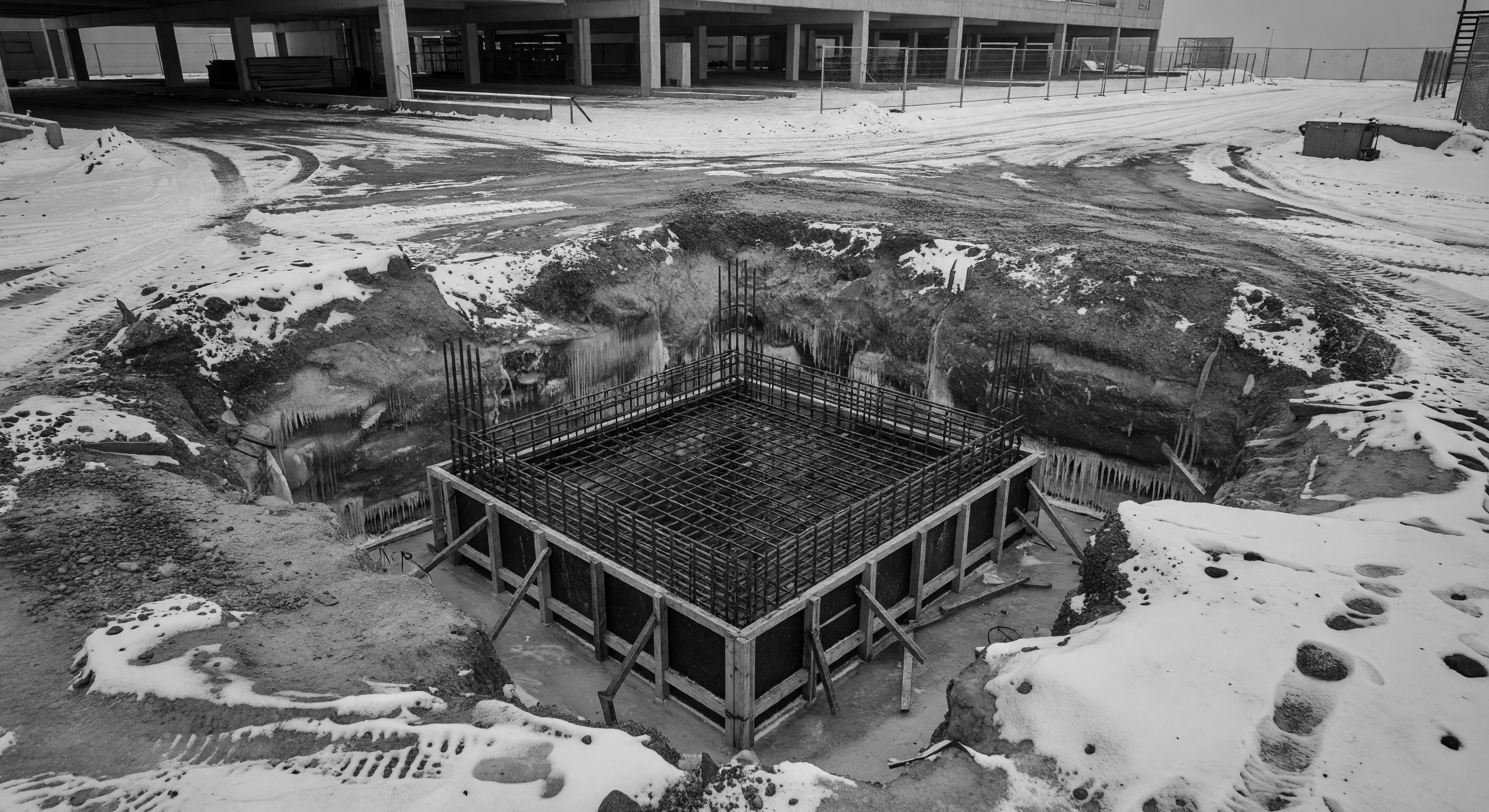
The standard gate-base detail is a reinforced concrete pier, typically 24-30 inches square at the top, flaring to 36 inches at the base, with a footing depth equal to or greater than local frost depth plus 6 inches of margin.
Reinforcement: four #4 vertical bars with #3 ties at 12-inch centers is the minimum for a standard gate. Heavy-duty industrial gates with 14-foot arms need #5 verticals. Tie the rebar cage to the gate’s anchor-bolt template before the pour so the bolts end up plumb to the footing axis.
Concrete: 4,000 psi minimum, air-entrained (6% ± 1.5%) in any freeze-thaw climate. Non-air-entrained concrete fails by surface scaling within 3-5 winters.
Drainage — The Underrated Variable
A foundation that stays dry does not heave. A foundation sitting in a saturated frost bulb can heave even at code-specified depths.
Practices that reduce heave risk regardless of soil:
- Gravel collar: 12-18 inches of free-draining #57 stone around the pier, wrapped in geotextile filter fabric, routes surface water away from the soil beside the foundation.
- Drain tile: A 4-inch perforated drain at the base of the excavation, daylighted or tied to a storm drain, prevents saturated soil from forming ice lenses against the pier.
- Surface grading: The pavement or topping must slope away from the gate base in all directions. A 2% slope over 10 feet is the minimum.
The U.S. Army Corps of Engineers Cold Regions Research and Engineering Laboratory (CRREL) publishes extensive guidance on frost-heave mitigation in pavement and shallow structure applications.
Insulation as a Design Tool
In extreme climates or sites where excavating to full frost depth is impractical (shallow utilities, bedrock, permafrost), extruded polystyrene (XPS) insulation panels placed horizontally around the foundation can simulate deeper burial. A 2-inch XPS panel extending 4 feet horizontally from the pier at 24 inches below grade effectively deepens the frost-free zone without deeper excavation. ASHRAE Handbook — Fundamentals Chapter 27 documents the thermal calculation.
Heated Pads and Permafrost
Arctic and subarctic installations occasionally use heated pads — electric heating cable embedded in the footing — to keep the base above freezing. This is a last resort, expensive to operate, and only appropriate where the site has reliable power and the alternative is annual foundation repair. Permafrost installations require specialized geotechnical engineering; treat them as civil projects, not barrier-gate projects.
Monitoring and Repair Triggers
Install a plumb reference on every gate at commissioning — a small notch in the base that can be measured against a rod each spring. Any gate out of plumb by more than one degree after a winter should be inspected: check limit switch drift, gearbox oil level, and arm counterweight balance. Two degrees or more usually means the foundation has failed and will continue to fail.
FAQ
What is the minimum foundation depth for a barrier gate in a cold climate?
Match local code frost depth plus 6 inches of margin. That ranges from 30 inches in the mid-Atlantic to 60+ inches in the northern tier. Check IBC tables and state amendments for your specific jurisdiction.
Will a concrete pad on top of asphalt work instead of a deep pier?
Only for the warmest climates. Surface-mounted pads experience full frost action and will tilt. If the site has utilities or bedrock preventing deep excavation, use a properly sized pier with horizontal XPS insulation wings rather than skipping depth.
Why does my gate lean after every winter?
Almost certainly foundation heave. Measure plumb deviation and compare to commissioning baseline. If deviation exceeds two degrees, plan foundation replacement rather than repeated realignment — shimming a heaving gate is a short-term fix.
Do I need air-entrained concrete?
Yes in any climate with freeze-thaw cycles. Non-air-entrained concrete scales and spalls within a few seasons of exposure to salt and freeze cycles. Specify 6% ± 1.5% air content with 4,000 psi minimum strength.
Hero image: “A snow covered parking lot at Mountain View Office Park during heavy snow” by Famartin, CC BY-SA 4.0, via Wikimedia Commons (https://commons.wikimedia.org/wiki/File:2026-02-23_02_33_45_A_snow_covered_parking_lot_at_Mountain_View_Office_Park_during_heavy_snow_at_the_height_of_a_winter_storm_in_the_Mountainview_section_of_Ewing_Township,_Mercer_County,_New_Jersey.jpg).
)