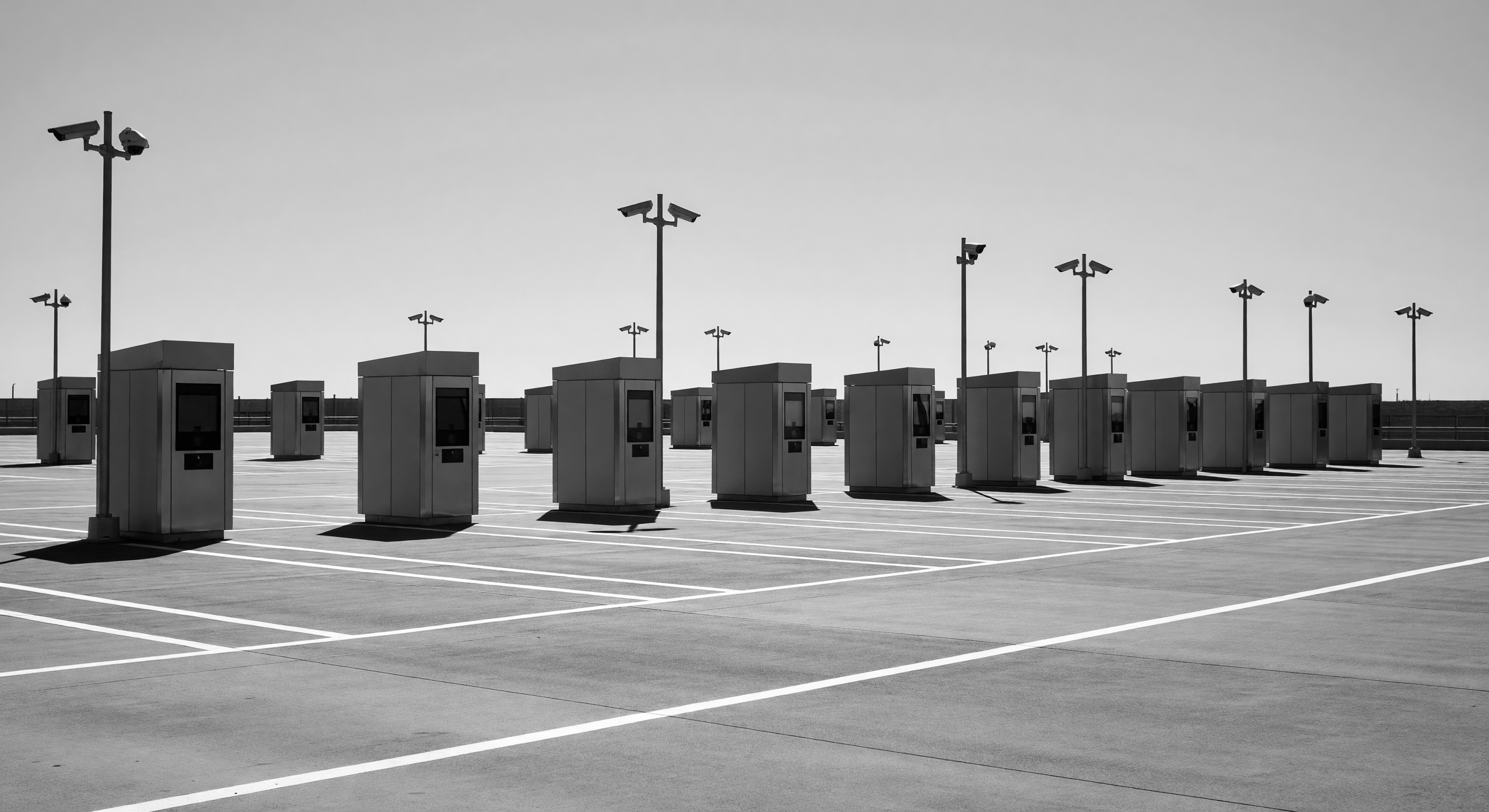
A single gate is an engineering problem. Two or more gates running in parallel is a systems problem. Crosstalk between inductive loops, arm-swing collisions, and command-timing mismatches all scale with the number of adjacent lanes — and the installers who handle single-gate projects well often stumble on their first two-lane plaza.
Large throughput facilities — airport rental return, stadium egress, toll plazas — routinely run four to eight coordinated gates. The practices below reflect what separates a plaza that clears 900 vehicles per hour from one that jams at 400.
Lane Spacing and Arm Geometry
Center-to-center lane spacing drives every other decision. Ten feet is the practical minimum for passenger vehicles with standard 10- to 12-foot arms; anything tighter and arm tips from adjacent gates risk contact during wind gusts or asynchronous open cycles. Twelve feet is preferred for mixed passenger/light-truck traffic, and 14 feet is standard where Class 8 trucks are expected.
Arm length is not simply “lane width plus curb clearance.” The swing radius of a rising gate sweeps through adjacent airspace during the open stroke. Two gates opening in opposite phase — one rising, one falling — create a scissoring hazard at the centerline. Plazas with high bidirectional coordination risk should spec arms with hard mechanical stops at 85 degrees rather than 90, reducing the overlap zone.
Loop Detector Isolation
Adjacent inductive loops induce voltage in each other. When a vehicle sits over the closing loop in Lane 1, the magnetic field can couple into Lane 2’s loop and cause a false presence call — the classic “ghost vehicle” that holds a gate open with no car under it.
Mitigation is layered. First, loops in adjacent lanes should be wound in opposite directions (clockwise in Lane 1, counterclockwise in Lane 2). Second, detector cards for adjacent lanes should be assigned non-adjacent frequencies — most multi-channel detector units support four or eight frequency slots for exactly this reason. The IMSA Vehicle Detector Field Guide documents crosstalk patterns observed in signalized intersections with similar geometry.
Command Synchronization
Not all multi-lane installs want synchronized gates. Rental car return plazas typically want independent per-lane operation so a stuck gate doesn’t block the whole exit. Toll plazas moving to open-road tolling want coordinated raise-on-transponder-detection to smooth flow. The controller architecture has to match the operational philosophy.
Synchronized plazas commonly use a master-slave topology: one controller reads all detection inputs and issues open/close commands to peer controllers over RS-485 or CAN. Latency between master command and peer arm motion should stay under 150 milliseconds to avoid visible stagger. When controllers come from different manufacturers, achieving that latency requires careful polling-rate tuning.
Shared Detection Strategies
High-end plazas share detection across lanes rather than treating each lane as independent. A single overhead LiDAR or radar unit can classify vehicles across four lanes and pre-queue gate-open commands before the vehicle reaches the individual lane loop. This reduces the “reaction gap” — the time between loop trigger and arm fully vertical — from the typical 1.2 seconds to under 400 milliseconds.
Shared detection requires a dedicated network segment. Mixing detection traffic with facility Wi-Fi or card-reader traffic introduces jitter that defeats the latency gain. Quality installations pull a separate low-voltage detection VLAN back to a dedicated switch in the gatehouse.
Power and Grounding
Multi-gate plazas should not daisy-chain power. Each gate controller needs a home-run circuit from the panel, and the panel needs a low-impedance ground reference shared across all gate enclosures. Differential ground potential between adjacent gates — even a few volts — introduces noise into the RS-485 bus and causes intermittent sync failures that baffle troubleshooters for months. NFPA 70 Article 250 bonding requirements are the floor, not the ceiling.
Commissioning Sequence
Commission gates one at a time, not as a group. Energize Lane 1 alone, verify detection, arm motion, and safety inputs, then power it down. Repeat for each additional lane. Only after all gates pass individual commissioning should the sync bus be connected and coordinated operation tested. Facilities that skip this sequence spend days chasing faults that would have been obvious in isolation.
FAQ
What is the minimum spacing between parallel barrier gates?
Ten feet center-to-center for passenger-only traffic with 10-12 foot arms. Twelve feet is preferred for mixed traffic, and 14 feet is standard for facilities serving Class 8 trucks or buses. Tighter spacing creates arm-collision risk during wind events or asynchronous operation.
How do I prevent loop crosstalk between adjacent lanes?
Wind adjacent loops in opposite directions and assign non-adjacent detector frequencies. Most quad-channel detector cards expose four frequency slots specifically for multi-lane use. Check the detector manufacturer’s application note — IMSA publishes general guidance.
Should each lane have its own controller or share one?
Share a master controller only when operational philosophy requires synchronized behavior (toll plazas, secure compounds). Independent controllers per lane are safer for throughput-focused applications like rental-car return, where one failed gate should not disable adjacent lanes.
What network should coordinate multi-gate commands?
A dedicated RS-485 or CAN bus, or a separate low-voltage VLAN if over Ethernet. Do not share the coordination network with card readers, cameras, or facility Wi-Fi. Jitter on the coordination bus produces visible stagger between gates.