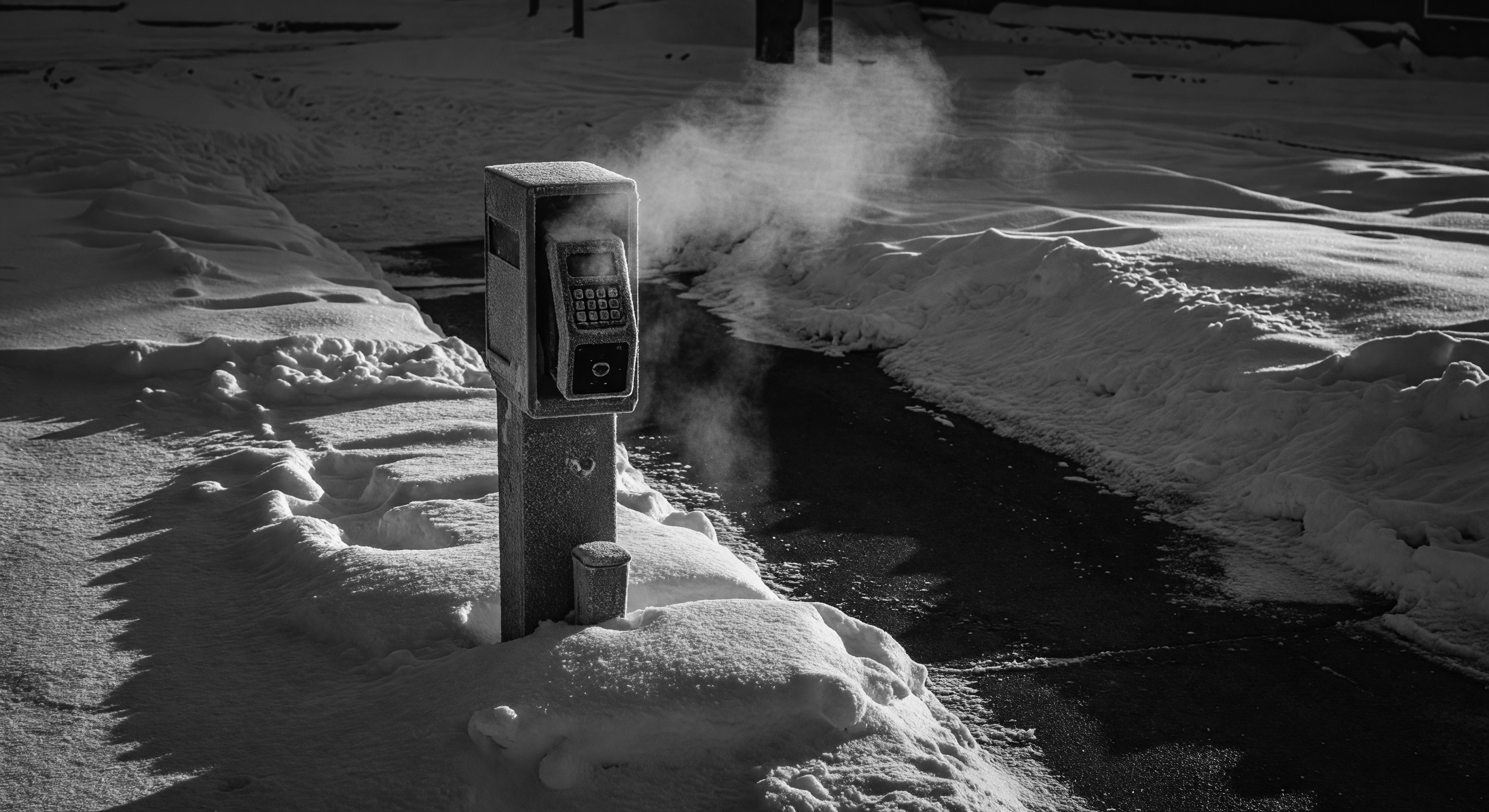
Barrier gate operators deployed in Minneapolis, Winnipeg, Anchorage and northern New England see ambient temperatures that most manufacturer datasheets barely acknowledge. The typical rating band printed on a spec sheet — -20 C to +55 C — describes a laboratory operating envelope. Real-world cold climate performance depends on what happens inside the housing, not just the outside air temperature.
Understanding the interaction between ambient temperature, lubricant viscosity, controller electronics, and condensation is essential to specifying gates that start reliably at 6 a.m. in February without requiring a service call every week.
What the temperature rating actually measures
When a manufacturer states an operator is rated to -30 C, that figure typically reflects one or more of the following:
- Motor starting torque at that temperature with specified lubricants
- Control board operating range (separately tested)
- Seal and gasket flexibility for ingress protection
- Housing material impact resistance
The rating rarely captures cumulative effects: a controller that boots reliably at -25 C after being warmed by cycling may fail to cold-start after a 72-hour power outage at the same temperature. Published ISO 16750 automotive environmental standards give a useful reference for how serious cold-soak testing is conducted; most gate operators are not subjected to that level of scrutiny.
Heated housings: more than a strip heater
A heated housing is not simply an enclosure with a resistive heater bolted inside. Well-designed cold-climate packages typically include:
- Thermostatically controlled heater sized to the housing volume, commonly 150-400 watts.
- Insulation on the housing interior — closed-cell foam or reflective barrier — to reduce duty cycle on the heater.
- Condensation management. A heater that cycles on and off produces condensation on cold surfaces, which then refreezes. Proper heated housings include drainage, hygroscopic elements, or continuous low-wattage trace heat rather than thermostat-controlled spikes.
- Separate controller bay heating. Electronics tolerate cold better than mechanical components, but cold solder joints and LCD displays can fail below -20 C.
Shops that skip insulation and run an oversized heater often trip the breaker during defrost cycles and see lubricant migration problems as the housing interior swings from +10 C to -25 C repeatedly.
Grease and gearbox behavior below freezing
Standard NLGI grade 2 greases stiffen significantly below -10 C. Gate operators used in cold climates should be specified with synthetic lubricants rated for the lowest expected service temperature — typically a PAO or PAG synthetic with a pour point of -40 C or lower.
Field signs of the wrong lubricant:
- Slow arm movement in the first three cycles of the morning, recovering after the motor warms the gearbox
- Motor thermal overload trips on cold starts
- Audible “groaning” from the gearbox in first cycle
- Increased current draw measurable on the motor supply
Asking the manufacturer for the factory-fill lubricant specification — and confirming whether a cold-climate variant is available — is a fifteen-minute conversation that prevents two years of winter service calls.
De-icing the arm and mounting area
Snow loading, ice buildup on the arm, and plowed snowbanks blocking arm travel are frequent causes of nuisance faults and physical damage. Approaches that work:
- Raised mounting pads above expected snow accumulation
- Arm position sensing (not just limit switches) so the controller detects obstruction during travel and reverses gracefully
- Breakaway arm couplings that release under lateral load from snowplows or vehicle strikes
- Heated boot area — some high-end operators offer an optional element at the arm pivot point to prevent ice binding
Arm heaters built into the arm itself exist but are uncommon in parking applications; they are more typical on rail crossing gates regulated by FRA standards.
Condensation: the underrated failure mode
More cold-climate controller failures come from condensation than from cold itself. A heated enclosure warmed to +15 C internal while the outside is -25 C will pull humid air in through any gap during thermal cycling. When the heater cycles off and interior temperature drops, moisture condenses on the coldest surface — often a terminal block or relay contact.
Mitigations:
- Conformal coating on control boards (factory option on most commercial operators)
- Sealed housings with desiccant packs, replaced annually
- Continuous low-wattage heating rather than on/off thermostat control
- Proper gland fittings on all cable entries
Frequently Asked Questions
What ambient temperature rating should I specify for a site in Calgary or Minneapolis?
Request a manufacturer specification of -30 C continuous with cold-start capability to -35 C. Verify the rating includes both mechanical and electronic components, not just the motor.
Do heated housings significantly increase electrical load?
Yes. A 300-watt heater running 30% duty cycle through a six-month winter adds roughly 400 kWh per gate. Budget accordingly and size service conductors with this continuous load in mind.
Can I retrofit a heater to an existing non-heated operator?
Sometimes. Manufacturer-approved heater kits exist for many platforms. Aftermarket heaters that are not approved can void warranties and create UL listing issues.
Is snow load a structural concern for arm selection?
Yes. Wet snow can add several kilograms to a 4 m arm. Specify arm materials and motor torque for the worst-case loaded condition, not the dry arm weight.