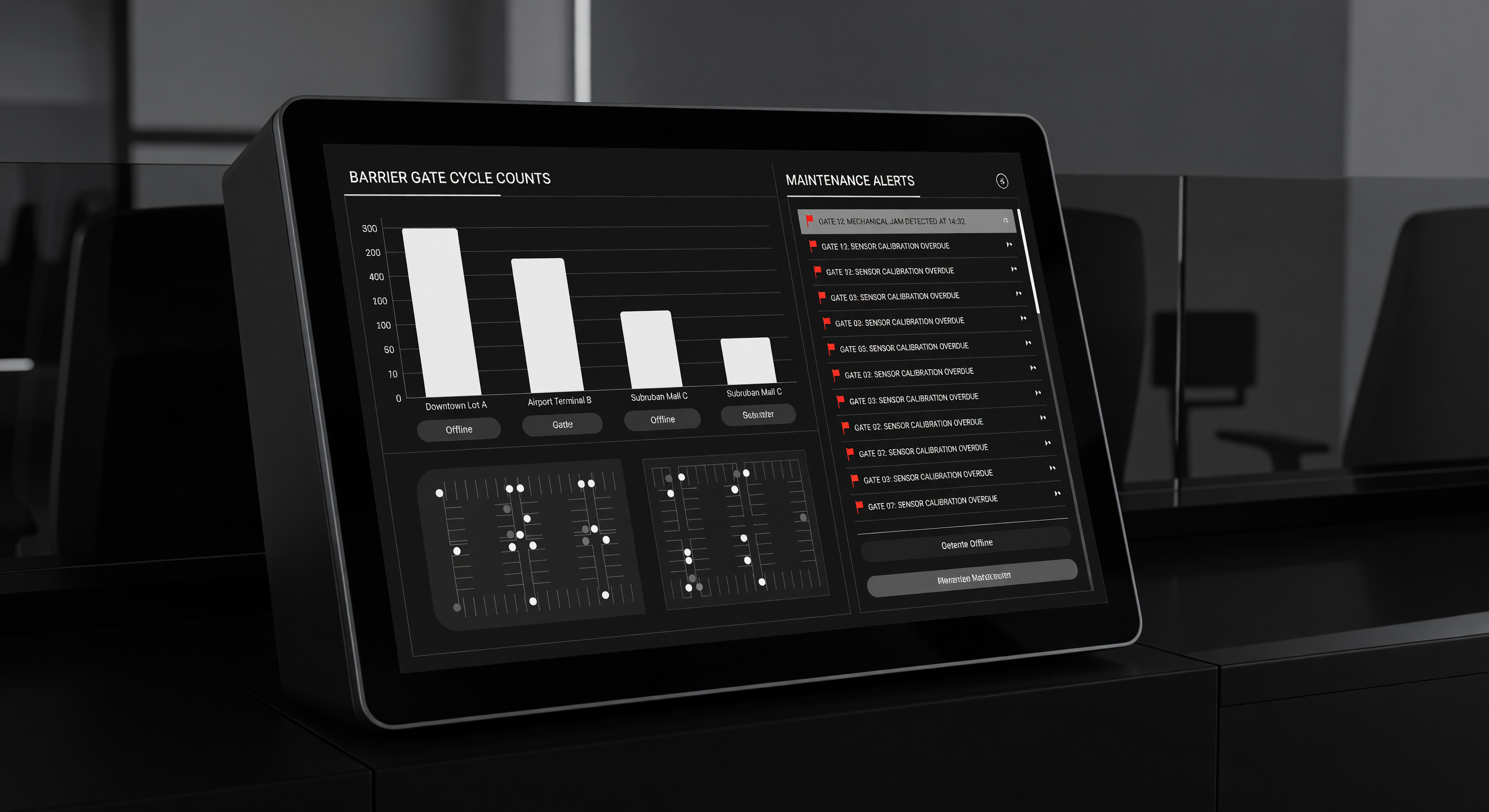
The cycle counter is the single most useful data point on a barrier gate, and the most ignored. Every modern controller logs total cycles since installation, cycles since last service, and — in better systems — cycle rate per hour. Yet most fleet operators look at the number only after a failure, when the data could have predicted the failure weeks earlier.
This is the framework used by operators managing 50+ gates across multiple sites: what to monitor, at what thresholds, and what to do when a number trips.
Baseline: Understand Your Duty Cycle Class
Barrier gates are rated in duty cycle classes. The UL 325 standard defines Class I through IV for vehicular gate operators, each with specific usage frequency assumptions. Industry practice, though, often uses a tighter framework:
- Class 1 (residential): ≤40 cycles/day, typically a private home
- Class 2 (light commercial): 40-300 cycles/day, small office lot
- Class 3 (standard commercial): 300-1,500 cycles/day, hotel or office garage
- Class 4 (heavy commercial): 1,500-6,000+ cycles/day, airport return, urban garage
Every metric below is interpreted against the gate’s class rating. A Class 3 gate showing 5,000 cycles/day is operating at 3x its rated duty and will fail early, regardless of what the maintenance log says.
Core Metrics
Total lifetime cycles: The odometer. Track it against the manufacturer’s published MTBF or design life. Most AC commercial gates publish 3-5 million cycle design life; DC residential gates publish 250,000-750,000. Exceeding design life doesn’t mean instant failure — it means repair probability climbs steeply with every additional cycle.
Cycles since last service: The service-interval metric. Published PM schedules usually cite months, but hour-based or cycle-based intervals track actual wear better. A gate at 50,000 cycles has worn more than a gate at 10,000 cycles even if both are at the same calendar age.
Cycle rate (per hour, per day, per week): The utilization metric. Unexpected changes matter more than the absolute number. A gate that averaged 400 cycles/day for a year and suddenly jumps to 900 cycles/day is experiencing either a use-case change (new tenant, new operating hours) or a detection problem (phantom triggers).
Incomplete cycles: The reliability metric. An incomplete cycle is an arm that started to move and did not reach its end stop within the expected time. Rising incomplete-cycle counts correlate strongly with upcoming motor, gearbox, or limit-switch failure.
Fleet-Level Alert Thresholds
These are practical thresholds used by fleet operators:
- Cycle rate deviation: More than 40% above 30-day rolling average triggers investigation. Usually phantom triggers or a gate stuck in an auto-cycle loop.
- Incomplete cycle ratio: More than 1% of cycles incomplete over a 7-day window triggers a service visit. Healthy gates run well under 0.1%.
- Cycles-to-next-PM: Schedule service when the gate reaches 80% of the target interval. A Class 4 gate on a 25,000-cycle PM interval gets scheduled at 20,000 cycles. Waiting until 100% guarantees some gates will overshoot.
- Lifetime cycles approaching design life: Flag for capital replacement planning at 70% of published design life. Procurement, budgeting, and installation scheduling all take longer than most operators plan for.
Data Collection Realities
Older gates log cycle counts only on a local mechanical or electronic counter. Reading them requires a site visit, and the data lives in a spreadsheet at best. Operators running 20+ gates cannot sustain that.
Modern systems with network connectivity report cycle data centrally. Minimum useful architecture:
- Controller logs cycles locally (non-volatile storage, survives power loss)
- Controller reports to a central server over cellular, Wi-Fi, or wired network
- Central server retains 2+ years of history for trend analysis
- Alerts fire on threshold breaches, routed to the right technician
Retrofitting network connectivity onto older gates usually costs $500-$1,500 per gate for a cellular gateway and integration labor. For fleets over ~10 gates, the ROI shows up within the first year through avoided emergency service calls.
What the Numbers Actually Predict
Rising incomplete cycles predict motor or gearbox failure 2-6 weeks out. The motor slows before it stops.
Rising total current draw per cycle (where logged) predicts gearbox bearing failure 1-3 months out. Friction climbs before the bearing seizes.
Cycle rate climbing above 1.5x baseline with no business reason predicts detector failure or arm-tip damage. Something is triggering the gate that shouldn’t be.
Flat cycle rate at zero predicts nothing — it means the gate has been stuck open or the controller has lost counting capability. Any gate reporting zero cycles for 24+ hours during business hours deserves an immediate check.
Integration with Work-Order Systems
The cycle data only matters if it drives action. Integrating gate telemetry into a CMMS (computerized maintenance management system) — IBM Maximo, eMaint, Fiix, or similar — converts thresholds into work orders automatically. The specific platform matters less than the integration discipline: every threshold breach should either produce a ticket or be explicitly acknowledged as noise and suppressed, not ignored.
ISO 55000 asset management principles apply directly — cycle counters are condition-monitoring inputs for a class of physical asset, and the same practices used for pumps, motors, and generators work on gates.
FAQ
How often should I check cycle counts on my gates?
Automated thresholds should evaluate them daily. Human review of a fleet dashboard weekly is plenty for most operators. Only post-incident review should look at individual gates.
What’s the most important cycle metric?
Incomplete cycle ratio. It directly predicts imminent mechanical failure and gives enough warning to schedule service rather than emergency response.
Do residential gates need cycle monitoring?
Generally no. At 20-40 cycles per day, residential gates have long service intervals (quarterly or annual visual inspection). Cycle telemetry pays off only above a few hundred cycles per day.
How do I get cycle data off an older gate with no network?
Cellular gateways with serial or dry-contact inputs read the gate’s pulse or status outputs and report to the cloud. Budget $500-$1,500 per gate installed. For small fleets, manual monthly reads remain viable.