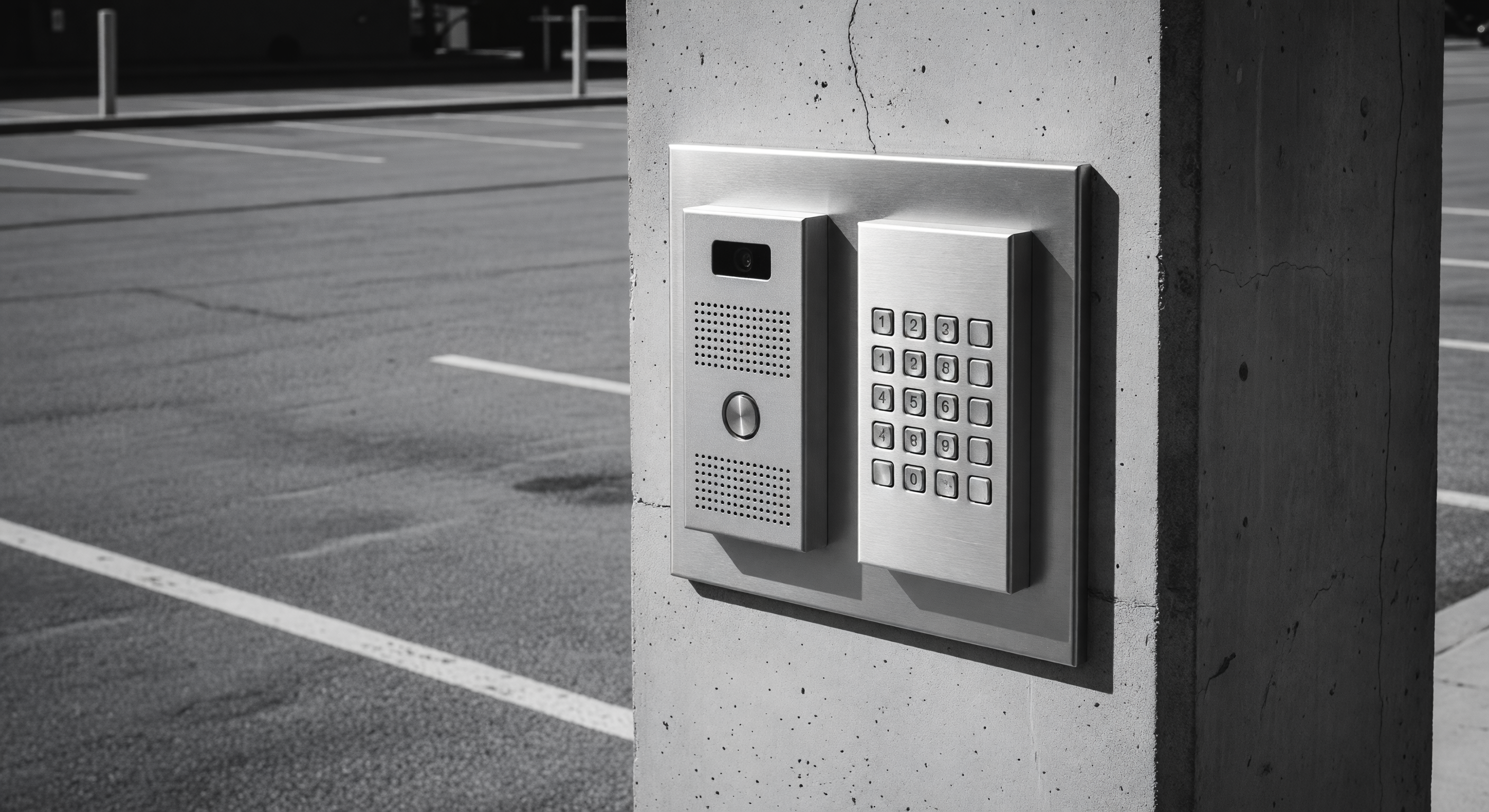
An unattended gate is a policy statement: “We trust the system, but we’ll talk to you if you need us.” The intercom is the fallback that keeps that statement workable. Without a reliable way to reach a human, unattended gates trap visitors who’ve lost credentials, dealt with failed readers, or arrived outside operating hours — and the support calls that should have taken 30 seconds become 20-minute escalations.
Intercom integration has shifted dramatically in the past decade. Analog 2-wire systems dominated through the 2010s; SIP/IP systems took the high end; cellular systems filled the gap for sites with no IT infrastructure. Each approach has a right use case and a set of pitfalls.
Analog 2-Wire Intercoms
The traditional parking intercom runs on two twisted-pair wires — one for voice, one for the call button. Voltage typically 12-48 VDC on the call pair; voice is unbalanced analog.
Advantages: Simple wiring, cheap hardware, predictable behavior, no IT involvement. Works on existing wiring in retrofit scenarios.
Disadvantages: Single-conversation limit (one call at a time across a site), no video, poor audio quality over distance (voice degrades noticeably past ~1,500 feet of 22 AWG), no integration with modern call-center platforms.
Right use cases: Small sites, retrofit on existing infrastructure, facilities with an on-site operator who answers at a desk phone.
Wiring practice: shielded twisted pair (Belden 9841 or equivalent), ground the shield at the head-end only, separate from power conductors by 12+ inches in conduit. Long runs benefit from a 1:1 audio transformer at each end to break ground loops.
SIP/IP Intercoms
SIP (Session Initiation Protocol) intercoms are network devices that register with a PBX or SIP trunk and route calls like any other phone extension. They can ring mobile phones, call centers, or distributed on-call rosters. Most support video, dial plans, and centralized management.
Advantages: Integration with modern UC (unified communications) platforms, video capability, centralized management of multiple gates, ring multiple destinations in sequence or parallel, integration with CRM and visitor management.
Disadvantages: Requires network infrastructure at the gate (PoE switch, fiber or copper back to the MDF, IT involvement), NAT/firewall configuration for off-net SIP trunks, failure modes tied to network health (a gate with a dead Ethernet switch can’t call anyone).
Right use cases: Commercial facilities with existing IT infrastructure, sites with distributed call handling, facilities integrating visitor management.
Power delivery: PoE+ (802.3at) or PoE++ (802.3bt) covers most IP intercoms. Outdoor pedestal installs need surge-protected PoE injectors to protect the switch. IEEE 802.3bt delivers up to 90 W, adequate for intercoms with integrated heaters and LED lighting.
Codec choice matters for audio quality. G.711 (PCMU/PCMA) is uncompressed and high quality but bandwidth-heavy (87 kbps each direction). G.722 is wideband HD voice and preferred for outdoor installations where wind and traffic noise challenge narrowband codecs. Opus is increasingly standard on modern platforms.
Cellular Intercoms
Cellular intercoms combine an intercom endpoint with an integrated LTE modem. The unit calls a designated number (or list of numbers) over the cellular network when the call button is pressed. Some models support SIP over cellular for integration with VoIP call centers.
Advantages: No local network infrastructure required, fast installation, suitable for remote sites or facilities without IT support, fail-open when facility network is down.
Disadvantages: Recurring carrier fees, coverage-dependent, occasional audio quality issues during network congestion, firmware and carrier certification dependencies (Verizon, AT&T, T-Mobile each certify devices separately).
Right use cases: Remote parking facilities, temporary installations, sites with no IT presence, standalone lots, disaster-recovery access points.
Carrier selection matters. Verizon’s LTE coverage leads in rural U.S.; AT&T leads in some urban and border areas; T-Mobile has expanded rapidly but lags in remote regions. Installers should field-test signal at the exact pedestal location — coverage maps do not reflect actual RSRP and SINR at ground level between buildings.
Video Intercoms
Video adds verification capability. An operator answering a call can see the driver, verify a visible credential (delivery badge, guest pass), and make credential decisions that audio alone couldn’t support. Modern units use H.264 or H.265 codecs and operate over SIP video (RFC 3261 + RFC 4566 SDP for video codec negotiation).
Lighting at the pedestal matters. IR illumination is standard on commercial units, delivering 10-30 ft working range in total darkness. Units without IR depend on ambient light and produce poor images at night. White-light LED illumination annoys drivers and should be avoided; IR is invisible to the eye while providing usable camera imagery.
Privacy considerations: Recording video from intercom calls may trigger state privacy laws. Most jurisdictions treat video as consentable by notice — posting “recorded for security purposes” signage at the gate is the usual threshold. Wiretapping laws around audio recording are more restrictive and vary by state (one-party vs two-party consent). Legal review before enabling recording is warranted.
Gate Controller Integration
The intercom has to talk to the gate controller to raise the arm when the operator authorizes. Common integration paths:
- Dry contact relay: Intercom closes a contact, gate controller sees the equivalent of a key-switch press. Simplest integration, universal compatibility.
- Wiegand output: Intercom sends a Wiegand credential to the gate’s reader input, gate controller processes it as a valid card read. Supports logging and audit trails.
- OSDP or proprietary API: Higher-end integrations where the intercom is a full participant in the access control system.
Dry contact is adequate for most use cases. OSDP integration justifies itself when operators need per-call audit logs (“which agent let this vehicle in?”) or when the gate and intercom are part of a unified security platform.
Power, Weather, and Physical Hardening
Outdoor intercoms face the same corrosion, lightning, and temperature stresses as the gate. Specify IP65 or IP66 rated units (or NEMA 4X enclosures), surge protection on every copper conductor (IEC 61643 Type 2 SPDs minimum), and internal heaters for cold-climate installations. Pedestal or wall-mounted units at driver-window height (42-48 inches above grade) are standard; ADA compliance requires at least one accessible unit per facility if the gate supports pedestrian or alternate-height use.
FAQ
What’s the best intercom technology for an unattended gate?
SIP over PoE for sites with IT infrastructure. Cellular for remote sites without network. Analog 2-wire only as a last resort or in retrofit scenarios. Video adds significant value wherever credential verification is part of the workflow.
Do I need video on the intercom?
Video helps operators make informed decisions — seeing a delivery driver with a package, or identifying a visitor holding a guest pass, closes the loop faster than audio alone. For high-security or high-volume unattended gates, video is the current standard.
Can my gate controller talk to any intercom?
Most can, via dry-contact relay. Tighter integration (Wiegand, OSDP, API) requires matching capabilities on both sides. Ask the gate manufacturer and intercom manufacturer for tested pairings rather than hoping for compatibility.
Is cellular service reliable enough for emergency intercom calls?
For routine visitor calls, yes. For safety-critical egress intercoms (trapped-in-lot panic buttons), cellular should be paired with a secondary path — SMS alerting to a backup roster, or a fail-over to a POTS line — because cellular outages do happen.
Hero image: “Dunai Waterworks Co., gate, boom barrier, 2020 Százhalombatta” by Globetrotter19, CC BY-SA 3.0, via Wikimedia Commons (https://commons.wikimedia.org/wiki/File:Dunai_Waterworks_Co.,_gate,_boom_barrier,_2020_Sz%C3%A1zhalombatta.jpg).


)