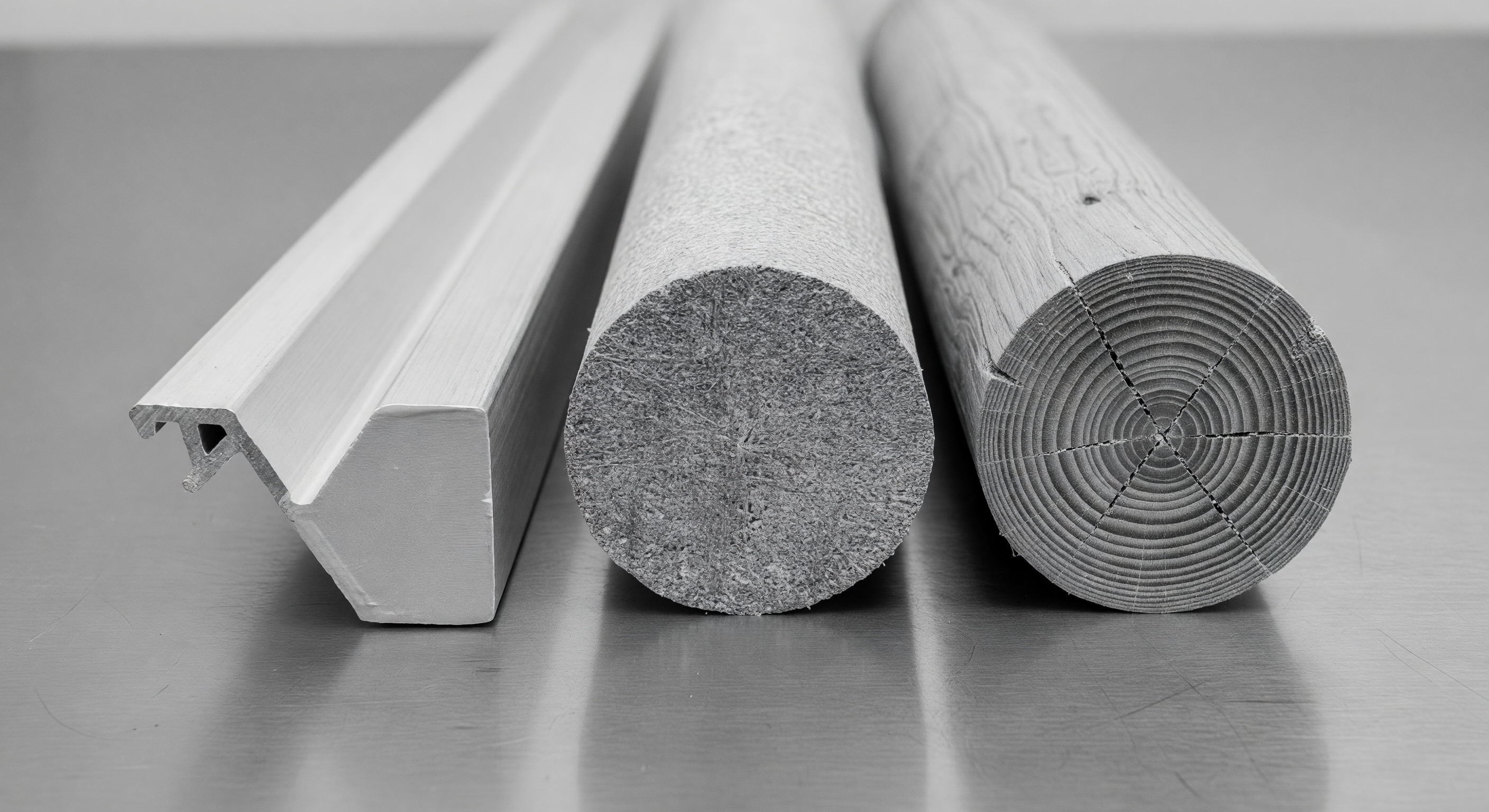
The barrier gate arm — the horizontal member that lowers to block traffic — accounts for a surprisingly small fraction of the overall gate cost but determines a large fraction of the gate’s practical behavior. Material choice affects impact response, weight balance, operator current draw, and the frequency of replacement events.
Three material classes dominate the market: extruded aluminum, fiberglass-reinforced composite, and traditional wood. Each has distinct characteristics that matter in specific deployment contexts.
Extruded Aluminum
The most common material in current commercial deployments. Extruded aluminum tubing in rectangular or oval cross-section, typically painted or powder-coated.
Behavior under impact: Aluminum deforms before it breaks. A vehicle strike at the gate tip typically bends the arm, sometimes severely, without severing it. The bent arm is immediately obvious and must be replaced, but the gate does not leave debris across the lane. Repair is a straightforward arm swap.
Weight and balance: Aluminum arms are moderately heavy. A standard 12-foot commercial arm weighs 15-22 pounds depending on cross-section. Gate operators are sized for this weight range as the baseline.
Lifespan and aesthetics: Powder coating lasts 5-10 years outdoors before noticeable degradation. UV exposure and road salt accelerate finish failure. Replacement cost is moderate — $150-300 per arm in typical commercial sizes.
Best for: General commercial and industrial use where moderate impact resistance, predictable repair cost, and common parts availability matter.
Fiberglass-Reinforced Composite
Increasingly specified for safety-critical applications. Pultruded fiberglass tubing with or without foam core reinforcement.
Behavior under impact: Fiberglass is the “break-away” option. Engineered composite arms are designed to fracture cleanly at a predetermined weak point when struck, reducing damage to the striking vehicle and eliminating the scenario where a bent aluminum arm pushes through a windshield. The tradeoff is that every strike produces a replacement event, whereas minor aluminum strikes might be straightened and returned to service.
Weight and balance: Fiberglass arms are typically lighter than aluminum — 8-15 pounds for equivalent length. Gate operators may need rebalance weights when switching from aluminum to fiberglass, or the motor will overrun its stops and trigger safety protection.
Lifespan and aesthetics: Fiberglass has excellent UV resistance and retains color for 10+ years with minimal degradation. Replacement cost is higher than aluminum — $250-450 for equivalent sizes — but the better finish retention can offset painting costs over time.
Best for: Public access sites where liability from arm-through-windshield events is a serious concern. Airports, hospitals, and high-traffic commercial facilities increasingly specify composite arms exclusively.
Traditional Wood
Increasingly rare in new installations but still found in retrofit contexts and residential applications. Painted softwood (usually spruce or pine) in a rectangular cross-section.
Behavior under impact: Wood fractures under heavy impact but behaves unpredictably. It may splinter, which creates a debris hazard; it may crack and remain attached, which can swing dangerously; or it may simply break clean. The unpredictability is why wood has largely been abandoned in commercial applications.
Weight and balance: Varies widely with species and moisture content. A 12-foot pine arm weighs 12-25 pounds depending on seasoning. Gate operator balance needs periodic adjustment as the arm’s moisture content changes with humidity.
Lifespan and aesthetics: Paint lasts 2-4 years before needing refinish. Wood itself is vulnerable to rot at the mounting hardware and at impact points. Total lifespan in outdoor commercial use is typically 3-6 years before replacement is required for reasons beyond the immediate impact event.
Best for: Residential HOA gates and historic-aesthetic applications where the wood appearance matters more than operational economics. Rarely the right choice in new commercial installations.
Operational Considerations Beyond Material
Breakaway couplings. These can be retrofitted to any arm type and provide the same safety behavior as fiberglass break-away arms while allowing aluminum’s other advantages. Couplings add $75-150 per gate but dramatically reduce post-strike service complexity.
Reflective accessories. Crossbuck panels, reflective tape, and LED lights in the arm itself are separate selections from the material choice but significantly affect nighttime visibility and liability exposure. Spec these based on the specific facility’s lighting conditions rather than defaulting to “whatever the manufacturer ships.”
Color choice. Red-and-white alternating is the North American standard for general commercial access. Orange-and-white is used in construction and industrial contexts. Black gate arms with reflective accents are increasingly specified in premium commercial sites where aesthetic integration matters.
Frequently Asked Questions
Is there an industry preference emerging?
Yes. Composite is becoming standard for new commercial installations in the United States and Canada, primarily driven by insurance carrier requirements and liability-reduction in risk reviews. Aluminum remains dominant in industrial and lower-duty commercial contexts. Wood is effectively obsolete for new installations.
Can I mix arm types in a multi-gate facility?
Yes, but it creates a service inventory burden. Maintaining spare arms in three materials across a 20-gate facility is more operational overhead than the cost savings typically justify. Standardizing on one material per facility is the usual recommendation.
Do break-away arms work with all gate operators?
Most. The arm attaches to a standard mounting plate; the break-away mechanism doesn’t interact with the motor or controller. Older gate operators may need balance adjustment when switching from solid aluminum to break-away composite, but no controller or motor changes are typically required.
What about metal arms with composite break-away sections?
These hybrid designs exist and combine aluminum’s straightening-repair capability with a designated fracture point. Adoption has been limited because the repair workflow is ambiguous — operators tend to either keep straightening the aluminum section indefinitely or replace the entire arm, neither of which uses the hybrid design’s intended behavior.
Hero image: “Barrier with gas-spring” by Silberwolf, CC BY-SA 2.5, via Wikimedia Commons (https://commons.wikimedia.org/wiki/File:Barrier_with_gas-spring.jpg).
)