“The gate won’t open” is the most common call a parking operator receives from drivers. In roughly three quarters of those incidents, the barrier mechanism is fine — the loop detector is misreading, mistuned, or physically damaged. Replacing the controller without diagnosing the loop itself is a fast way to waste money.
Loop detectors are deceptively simple: an inductive wire embedded in pavement, connected to a frequency-tracking controller. The physics hasn’t changed in forty years. But the failure modes are specific and the diagnostic path is well-established.
The Diagnostic Sequence
Start at the controller, work outward. Skipping steps is how you end up recutting pavement for a problem that was a loose terminal block.
Controller sensitivity: Most detectors run sensitivity levels 1-8. Level 5 is the default. Concrete-embedded loops often need level 6-7; asphalt loops rarely need above 5. If a gate “sometimes” misses small vehicles, bump sensitivity one step before doing anything else.
Inductance reading: Every quality controller displays the loop’s inductance value. Healthy commercial loops read 80-300 µH. Values outside that range almost always indicate a wire problem — broken turn, water ingress, or failed splice.
Frequency stability: Controllers display loop frequency, typically 30-130 kHz. If the reading drifts more than ±2% over a minute with no vehicle present, the loop has intermittent continuity. The usual suspect is the under-pavement splice from loop-wire to lead-in.
Common Failure Modes
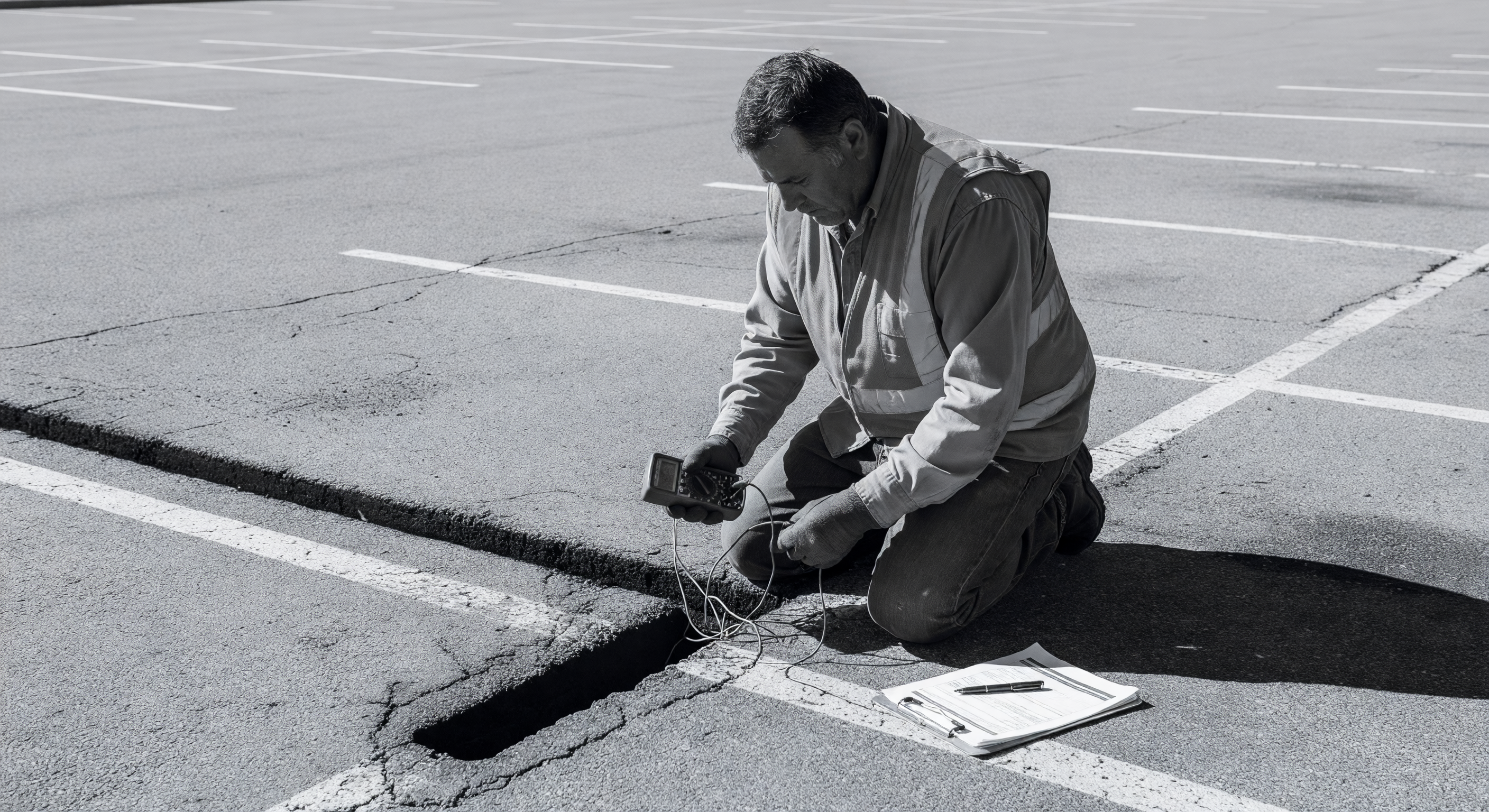
Broken turn: Sealant failure or pavement cracking severs one of the loop’s copper turns. Inductance drops sharply (often below 40 µH). The loop may still detect large vehicles but miss motorcycles and low-clearance cars. Repair is typically a recut of the damaged portion.
Crosstalk between adjacent loops: In multi-lane installations with loops closer than 2 meters, magnetic coupling between loops can cause one lane’s detection event to trigger the other’s gate. Controllers have crosstalk filters; enabling them on both sides usually resolves the issue.
Lead-in failure: The lead-in cable running from the loop to the controller housing is exposed to rodent damage, freeze-thaw cycling, and UV. It fails far more often than the loop itself. A continuity check from controller terminal block to loop splice point takes five minutes and saves hours of pavement work.
Power line interference: Loops near high-voltage transformers or variable-frequency drives (in elevator equipment rooms, for example) can pick up 60 Hz noise that presents as false detections. Grounding the loop shield and moving the controller to a different circuit is the standard fix.
Preventive Measures
Record baseline inductance and frequency values for every loop at commissioning. A semi-annual re-measurement catches degradation six months before it becomes a service call. This takes ten minutes per loop and is the single highest-ROI maintenance task on a barrier gate system.
Frequently Asked Questions
How long should an embedded loop last?
A properly installed loop — 4 turns of 18 AWG or heavier stranded wire, sealed with polyurethane, in a saw-cut at least 40mm deep — should provide 10-15 years of service. Shorter lifespans almost always trace to sealant choice or cut depth rather than the wire itself.
Can I diagnose a loop without a controller display?
A handheld LCR meter reads inductance directly at the controller terminal block. If you have the original commissioning notes, comparing current inductance to baseline is the fastest diagnostic available, faster than cycling through the controller’s display modes.
Are preformed loops worth the premium?
For new construction where the slab hasn’t been poured, yes. Preformed loops in a PVC carrier eliminate most installation failures and typically outlast saw-cut loops by 3-5 years. For retrofit installations, the saw-cut approach is still standard.
What causes a loop to detect bicycles and pedestrians falsely?
Over-sensitive tuning, usually from a technician trying to make a failing loop work. If you’re dropping sensitivity below 5 to eliminate false triggers, the underlying loop or splice is damaged — the sensitivity setting is masking, not solving, the problem.