Accessible parking compliance usually focuses on the striped stall, the access aisle, and the path of travel to the building. The gate at the lot entrance is often overlooked — yet the gate’s pay-on-foot station, ticket dispenser, or intercom are all “operable parts” under the ADA 2010 Standards for Accessible Design and must meet specific reach, clearance, and usability requirements.
Getting this wrong creates legal exposure and operational problems: drivers unable to reach a ticket from a vehicle, wheelchair users unable to operate a kiosk, and intercom call buttons mounted where only a standing adult can press them.
Which provisions apply to gate equipment
The relevant sections of the ADA 2010 Standards for most gate installations:
- Section 309 — Operable Parts. Covers reach range, clear floor space, and operation force.
- Section 308 — Reach Ranges. Defines forward and side reach maxima.
- Section 305 — Clear Floor or Ground Space. Defines the 30" x 48" space required at operable parts.
- Section 502 — Parking Spaces. Defines accessible parking stall requirements.
For kiosks and ticket dispensers interacted with from a vehicle, U.S. DOT has issued guidance on “drive-through” accessibility that clarifies reach from a driver’s seated position in a vehicle is not the reach envelope the ADA governs — the ADA reach envelope governs pedestrian interaction.
Reach range basics
Forward reach (unobstructed): 15" minimum to 48" maximum above the ground. Forward reach (obstructed): varies with depth of obstruction, but maximum is 44" above the ground where obstruction depth is up to 20". Side reach (unobstructed): 15" minimum to 48" maximum. Side reach (obstructed): 48" maximum with obstruction up to 10" deep; reduced to 46" with obstructions 10-24" deep.
For a typical pay-on-foot kiosk with a ticket slot, card reader, receipt printer, and display screen, all operable parts — anything a user must touch, insert, or press — must fall within these ranges. A receipt printer mounted at 52" AFF is noncompliant; a ticket slot at 58" AFF is noncompliant.
Clear floor space at the operable part
A 30" x 48" clear floor space positioned for forward or side approach is required at each operable part. This space must:
- Be stable, firm, and slip-resistant (not gravel, not a grate with openings larger than 1/2")
- Have a running slope no steeper than 1:48 (approximately 2%)
- Connect to an accessible route (cannot be isolated)
In practice this means kiosks cannot be placed such that the only approach is from an 8% asphalt slope or across an expansion joint with a 3/4" vertical discontinuity.
Drive-up vs walk-up configurations
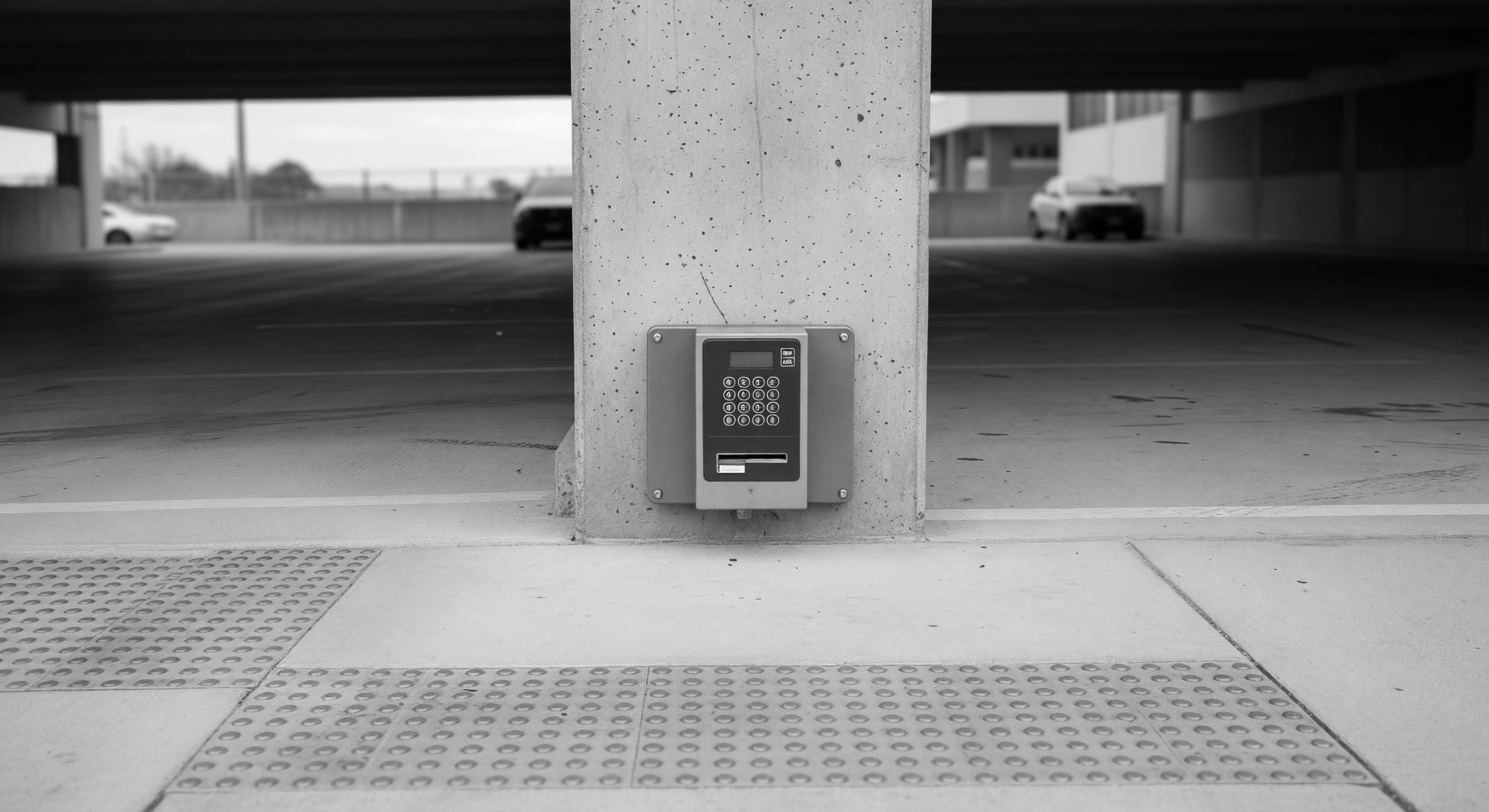
Most parking gate entries use a drive-up ticket dispenser. The dispenser itself is typically not considered an ADA operable part because it is designed for vehicle interaction — the driver reaches from the vehicle. However, if a person on foot (a driver whose vehicle stalled, a patron walking to retrieve a lost ticket) might reasonably need to operate the dispenser, it should meet ADA reach envelope requirements.
Walk-up pay stations and intercom call boxes, by contrast, are clearly operable parts and fully subject to Section 309.
Intercom and call button placement
Call boxes for assistance are among the most commonly noncompliant pieces of gate equipment. Typical violations:
- Call button mounted at 52-60" AFF to match a standing driver’s door-window height, exceeding the 48" maximum reach
- No clear floor space adjacent — the call box sits on an island with a curb
- Two-way audio that relies on visual cues (an “I’m speaking” light) without an alternative indicator for users who are deaf or hard of hearing
Best practice for compliant call boxes:
- Button and microphone between 15" and 48" AFF
- 30" x 48" clear floor space adjacent, accessible by a compliant route
- Audio paired with a visual indicator (signal LED confirming call connected)
- Tactile identification of the button (raised icon or braille label)
Operating force
Operable parts must require no more than 5 pounds of force to operate and must be usable with one hand, without tight grasping, pinching, or wrist twisting. Push buttons, card reader slots, and ticket slots generally meet this easily. Older mechanical coin slots and some keyed overrides do not.
Accessible route integration
A gate is part of an accessible route if pedestrians traverse it. In mixed-use garages where drivers walk past the gate to enter the facility, the gate area is part of the accessible route and must provide:
- 36" minimum clear width
- Surface meeting 302 (firm, stable, slip-resistant)
- Openings no larger than 1/2" in the direction of travel
- Changes in level no greater than 1/4" vertical, or 1/2" beveled at 1:2
Gate arms that descend across an accessible pedestrian route create obstruction concerns. Where pedestrians share the path, dedicated pedestrian gates or separated walkways are preferred.
Signage
Accessible parking requires signage per Section 502.6 — the International Symbol of Accessibility mounted at a minimum 60" AFF to the bottom of the sign. Directional signage to accessible parking from the gate entry should be clear and legible, with high-contrast text per Section 703.5. Proposed Public Right-of-Way guidelines provide further detail on accessible signage for outdoor environments.
Frequently Asked Questions
Does ADA apply to all parking gates or only public facilities?
ADA Title III applies to places of public accommodation and commercial facilities. Most commercial parking falls under this umbrella. Private residential parking is generally exempt. State and local codes (California Title 24, for example) can impose additional or stricter requirements.
Can I lower a non-compliant kiosk rather than replace it?
Sometimes — if the kiosk has mounting flexibility and the operable parts end up within range after lowering. Often the kiosk body is designed for drive-up heights and the interior component layout cannot be re-homed to meet pedestrian reach envelopes, requiring a different model.
What are typical enforcement scenarios?
Private lawsuits under Title III are the most common enforcement mechanism. DOJ also conducts investigations. Settlements typically require remediation and sometimes civil penalties.
Does the access aisle next to an accessible parking stall need to extend to the gate?
The accessible route from the stall to the building must be continuous and compliant. It does not need to pass through the gate, but if it does, the gate area must meet route requirements.