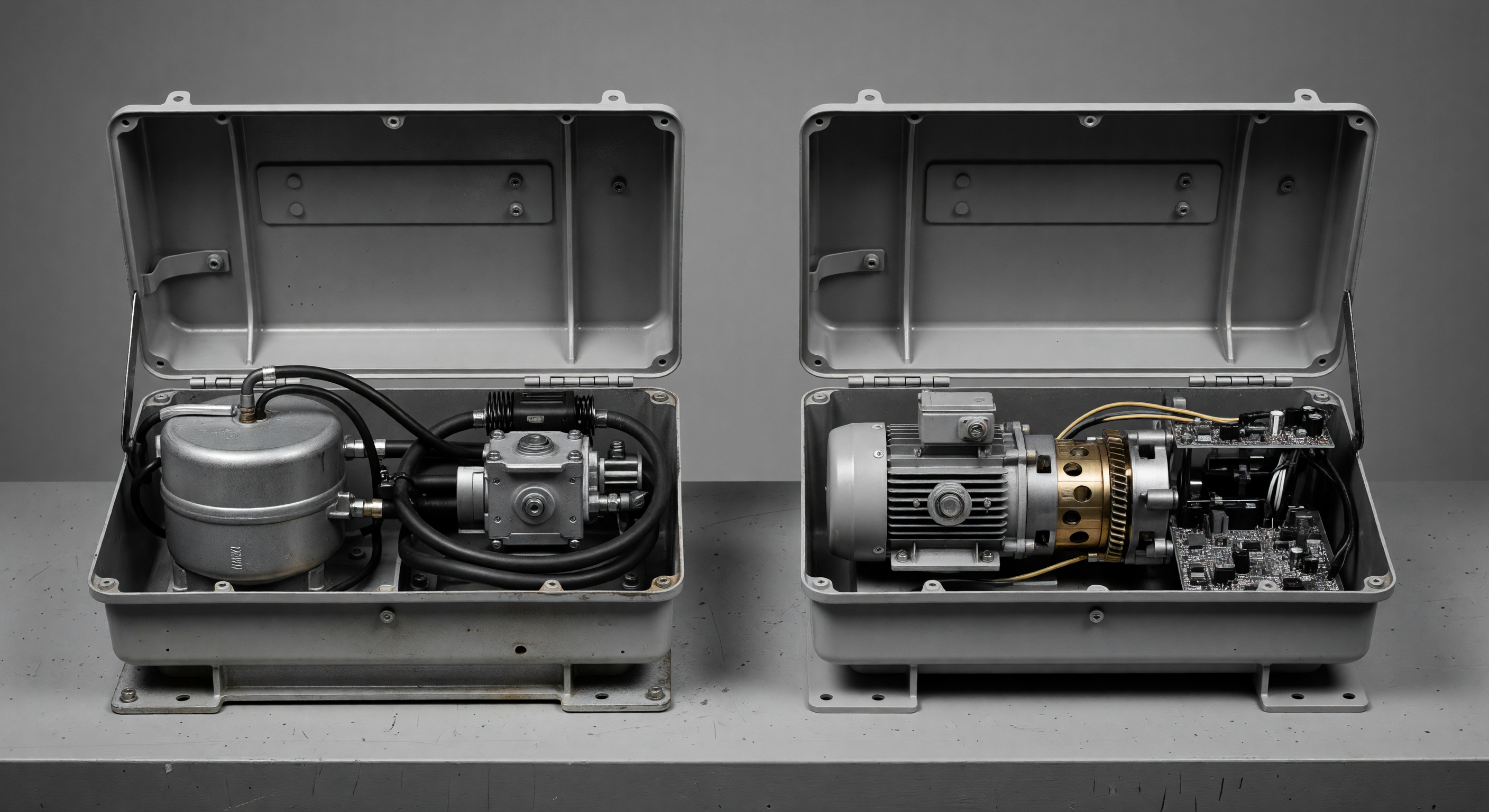
The hydraulic-versus-electric debate in barrier gate specification is older than most of the gates currently in service. Both technologies have matured significantly, and the answer is not “one is better.” The correct choice depends on duty cycle, climate, maintenance resources, and the specific application — toll plaza, parking garage entrance, industrial security gate, or commercial office lot.
Getting past marketing claims requires looking at actual service data, parts availability, and how each platform behaves after five years of real use.
How each works
Electromechanical operators use an AC or DC motor driving through a gearbox (worm gear, planetary, or harmonic) to a crank or lever arm that raises and lowers the barrier. Limit switches or absolute encoders define end-of-travel positions. Modern electric operators use VFD-driven AC motors or sensorless DC brushless motors with precise speed profiles.
Hydraulic operators use an electric motor driving a hydraulic pump that pressurizes a cylinder or rotary actuator. Hydraulic lines couple the power pack to the actuator, with valves controlling flow rate and direction. Some designs integrate the pump and actuator in a single sealed unit; others separate them.
Duty cycle and heat
At low duty cycles (under 200 cycles per day), both technologies perform essentially identically. The divergence appears at high cycle counts.
Hydraulic systems excel at sustained high-cycle operation because the fluid itself carries heat away from the motor and pump. A properly designed hydraulic operator can run 2,000+ cycles per day indefinitely with no thermal derating. Toll plazas and airport exit lanes have historically favored hydraulic for this reason.
Electromechanical operators at high cycle counts rely on gearbox thermal mass and motor duty ratings. Class IV electric operators are available but typically more expensive at the high end of the volume spectrum than equivalent hydraulic units.
Cold climate performance
Hydraulic fluid viscosity rises sharply at low temperatures. A system running ISO VG 32 hydraulic oil sees significant flow restriction below -15 C, slowing gate motion and increasing pump load. Cold-climate hydraulic systems either:
- Use lower-viscosity synthetic fluids (ISO VG 22 or lighter)
- Include reservoir heaters
- Accept slower winter cycle times
Electromechanical operators with synthetic gearbox lubricants generally handle cold better out of the box, though motor starting torque at -30 C still requires proper sizing.
For CAME, HUB, FAAC, Magnetic Autocontrol and others serving the North American cold-climate market, both technologies are offered with winterization packages; the difference narrows at the top of each product line.
Maintenance profile
Electric operator maintenance:
- Gearbox lubrication checks: annual
- Motor brush inspection (DC brushed motors only): every 2-5 years
- Control board inspection: annual
- Limit switch verification: quarterly
- No fluid to leak
Hydraulic operator maintenance:
- Fluid level check: monthly
- Fluid analysis (particle count, water): annual
- Filter replacement: annual or biennial
- Hose and fitting inspection for seepage: quarterly
- Seal replacement: 5-10 year interval
- Fluid disposal per local environmental regulations
The hydraulic maintenance cycle is more involved but highly predictable. The electric cycle is lighter but can be surprised by electronic failures that require board-level replacement. EPA hazardous waste guidance applies to used hydraulic fluids in many jurisdictions.
Failure modes
Hydraulic failures tend to announce themselves: seepage at fittings, slow movement, fluid loss. Most are gradual.
Electromechanical failures are more bimodal: a gate works, then doesn’t. Control board failures, motor winding opens, and gearbox bearing failures often provide little warning.
From a facility operations perspective, graceful degradation favors hydraulic. From a parts-on-shelf standpoint, electric favors standardization — a spare motor and board kit typically suffices, whereas hydraulic requires matched components and clean fluid handling.
Acquisition cost vs total cost of ownership
Acquisition cost for comparable duty ratings:
- Low-volume Class II: electric typically cheaper
- Mid-volume Class III: comparable
- High-volume Class IV / continuous duty: hydraulic historically cheaper at the top of the range, though premium electric options have closed the gap
Total cost of ownership over 10 years depends heavily on local service rates. Hydraulic requires trained hydraulic techs. Electric requires electrical/electronic techs plus mechanical. Most full-service contractors handle both; in-house staff varies by facility.
Where each wins
Electric wins at:
- Low-to-medium volume parking (under 500 cycles/day)
- Sites with limited in-house hydraulic expertise
- Indoor and garage applications
- Applications prioritizing quiet operation
Hydraulic wins at:
- High-volume toll and airport applications
- Sites with existing hydraulic maintenance infrastructure
- Outdoor applications in extreme heat
- Applications needing long arms (6+ m) with high torque demand
Frequently Asked Questions
Do hydraulic gates leak?
Well-maintained hydraulic gates do not leak meaningfully. Seepage at fittings during the first 100 hours of operation is normal and resolves with snug-up. Active leaks indicate seal or hose failure and should be addressed immediately.
Are electric gates quieter?
Generally yes, particularly modern sensorless DC brushless designs. Hydraulic pumps generate noise at startup and during travel; some models are noticeably louder in residential settings.
Is one technology becoming dominant?
Electric has gained share in parking applications over the past decade as VFD and brushless motor technology has improved. Hydraulic remains dominant in toll and high-security applications.
Can I retrofit a hydraulic gate with an electric operator?
Yes, though the foundation, mounting hardware, and arm hub often differ. Full operator replacement rather than internal conversion is typical.
Hero image: “Gas spring-2” by Silberwolf, CC BY-SA 2.5, via Wikimedia Commons (https://commons.wikimedia.org/wiki/File:Gas_spring-2.jpg).

)