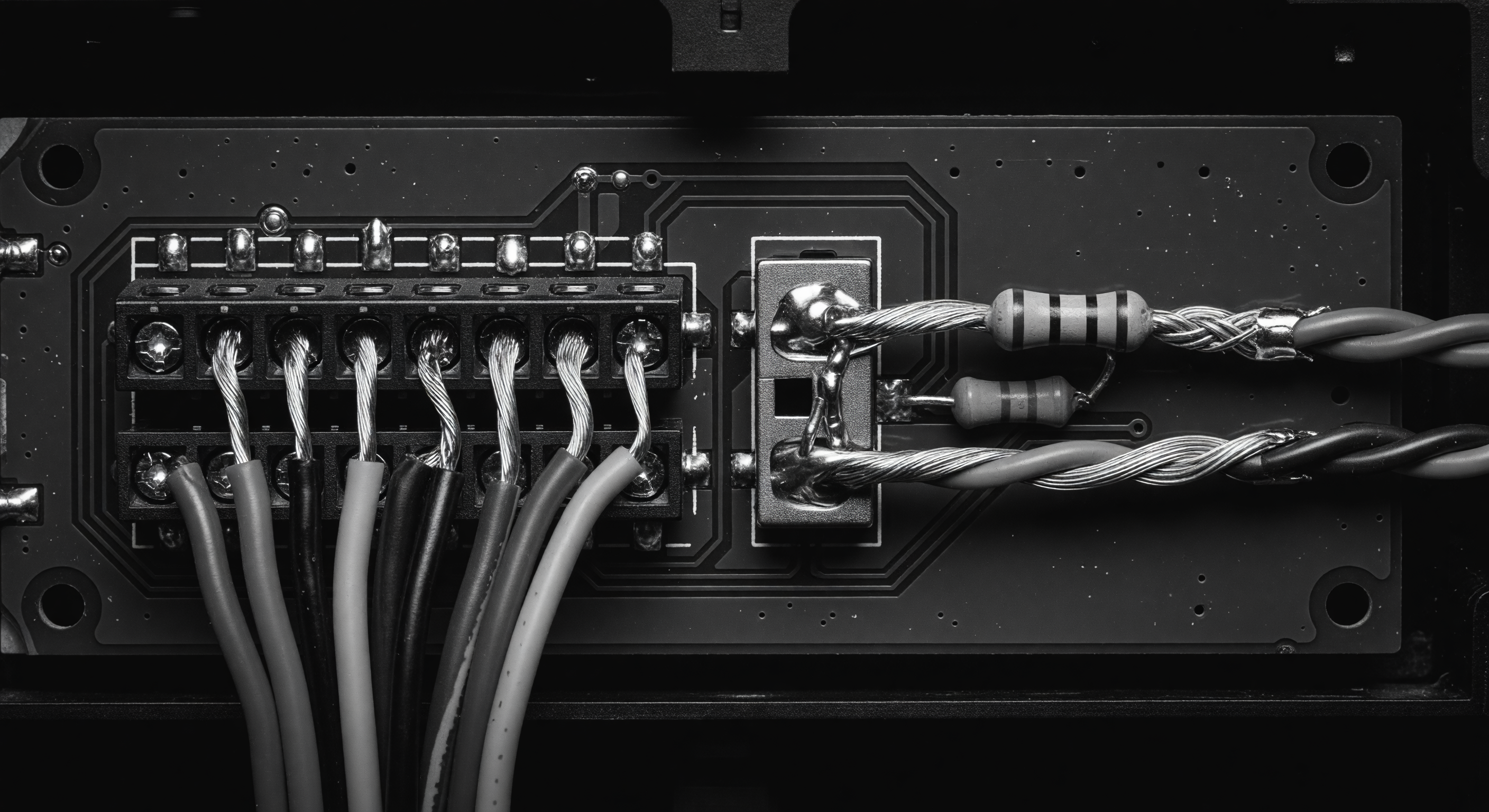
Most barrier gates in service today receive their “open” command from a card reader, keypad, or mobile credential system communicating over the Wiegand protocol. Wiegand has been the de facto standard in physical access control since the 1980s. The Security Industry Association’s Open Supervised Device Protocol (OSDP) has been formally standardized since 2011 and is steadily displacing Wiegand in new installations, with SIA OSDP v2.2 having achieved IEC international standard status.
For facilities specifying new gates or upgrading access control head-ends, understanding the practical differences between the two protocols affects wiring, cable runs, cybersecurity posture, and long-term upgrade paths.
What Wiegand does well
Wiegand is a one-way, unsupervised data protocol using two signal lines (Data 0 and Data 1) plus power and ground. When a credential is presented, the reader pulses the lines to transmit card data — typically 26, 34, or 37 bits depending on format.
Strengths:
- Extremely simple wiring: four to six conductors
- Universal compatibility: virtually every reader and controller manufactured in the past 40 years supports it
- No configuration: plug in, it works
- Low cost
Weaknesses:
- One-way only: controller cannot confirm reader is functional
- No encryption: data on the wire is readable with a logic analyzer
- Limited cable distance: ~150 m typical, less with thin-gauge cable
- Card data format proliferation: 26-bit Wiegand has only ~65,000 unique numbers and is widely cloned
For a gate at the end of a short cable run with a standard prox card system, Wiegand works and will continue to work. For anything involving long cable runs, site security concerns, or multi-factor authentication, it hits its limits.
What OSDP changes
OSDP is a bidirectional, supervised protocol over RS-485 serial. A single twisted pair can serve a daisy chain of up to 32 readers on one controller port. The protocol supports:
- Supervision. Controller polls readers continuously; failure or tamper produces an immediate alert.
- Secure Channel (OSDP-SC). AES-128 encryption using a mutual authentication handshake. Card data, commands, and responses are all encrypted.
- Longer cable runs. Up to 1,200 m on proper RS-485 cable.
- Bidirectional commands. Controller can command reader LED, buzzer, display — useful for visitor management and conditional access.
- Firmware updates over the wire. Readers can be updated without a site visit.
The security argument alone moves most federal and enterprise installations to OSDP. NIST and CISA guidance on physical access control increasingly cites OSDP as the preferred protocol for government and critical infrastructure.
Wiring differences
A Wiegand run:
- 6-conductor cable (18-22 AWG)
- Reader mounted, wired directly back to controller
- One reader per controller port
An OSDP run:
- 2-conductor twisted pair for data, plus separate power pair
- Shielded Belden 9841 or equivalent recommended
- Multiple readers daisy-chained or home-run depending on topology
- 120-ohm termination resistors at each end of the RS-485 bus
For a gate kiosk with multiple readers (entry and exit, or multiple credential types), OSDP’s daisy chain meaningfully simplifies cabling.
Backward compatibility and migration
Nearly every OSDP reader sold today also supports Wiegand via DIP switch or configuration, which allows phased migration:
- Replace legacy Wiegand readers with OSDP-capable readers set to Wiegand mode.
- When ready, upgrade the controller or add an OSDP interface module.
- Switch readers to OSDP mode, re-terminate cables if needed, configure the bus.
This approach lets a facility upgrade the hardware without immediately changing the access control head-end, avoiding a forklift replacement.
Not every gate controller natively speaks OSDP. Many accept Wiegand input from an external reader and translate that into a dry contact closure to the gate. For those installs, the access control panel speaks OSDP to the reader, then outputs Wiegand (or dry contact) to the gate — which is perfectly acceptable and common.
Cybersecurity considerations
Unencrypted Wiegand credentials can be captured with inexpensive sniffer tools placed in-line with the reader cable. Published demonstrations (ESPKey, BLEKey, and similar research tools) have shown this for years. For a parking gate controlling a surface lot, the practical exposure is limited. For a gate controlling a data center loading dock or a gated corporate campus, the exposure is meaningful.
OSDP-SC removes that attack vector. Proper implementation requires:
- Secure Channel enabled (not all OSDP deployments enable it — check configuration)
- Site-unique base keys, not factory defaults
- Key rotation policy documented
- Tamper switches active on reader housings
Frequently Asked Questions
Can I mix Wiegand and OSDP readers on the same gate controller?
Typically yes, through separate ports or an interface module. The reader-to-gate path can differ from the reader-to-head-end path.
What’s the typical cable distance improvement?
Wiegand reliably runs 150 m; OSDP on shielded twisted pair runs 1,200 m. The practical impact is fewer intermediate enclosures and less conduit.
Does OSDP require special installer training?
RS-485 wiring requires more care than Wiegand — proper termination, daisy-chain topology, shield grounding at one end only — but it’s standard serial bus practice. Most commercial installers handle it.
Is Wiegand going to be discontinued?
Not in the foreseeable future for the installed base. New installations increasingly specify OSDP. Wiegand readers and controllers will remain available for replacement use for years.