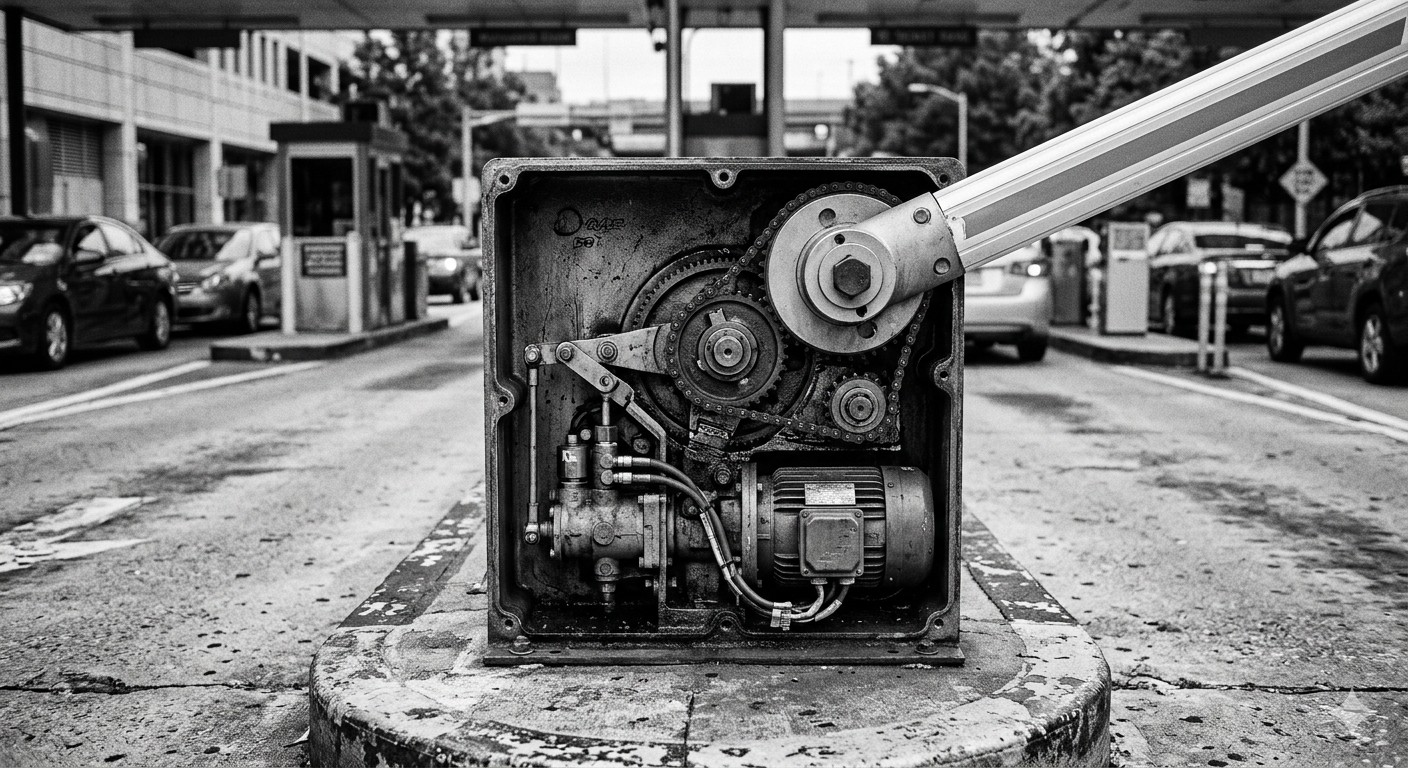
Automatic car park barriers look simple from the outside — a metal arm goes up, a car drives through, the arm comes back down. But inside the housing, there is an engineered system of motors, gearing, sensors, control logic, and safety mechanisms that must operate reliably through hundreds of thousands of cycles in all weather conditions.
Understanding how these systems work helps you make better purchasing decisions, troubleshoot problems faster, and communicate more effectively with installers and service technicians. This article breaks down the technology inside a modern automatic barrier gate, component by component.
The Core Components
Every automatic barrier gate consists of five core systems working together:
- Drive mechanism — the motor and gearing that physically move the arm
- Controller — the electronic brain that coordinates operation
- Detection system — sensors that detect vehicles and ensure safety
- Access control interface — the method by which the gate receives open/close commands
- Safety system — the mechanisms that prevent injury and damage
Let’s examine each one in detail.
Drive Mechanisms: How the Arm Moves
The drive mechanism is the heart of the barrier gate. Three main technologies are used in modern gates, each with distinct characteristics.
Electromechanical Drive
The most common drive type in commercial barrier gates. An electric motor turns a gearbox, which converts rotational speed into the slower, higher-torque movement needed to raise the arm. The connection between gearbox and arm varies:
- Crank arm linkage: The gearbox rotates a crank that pushes a connecting rod attached to the barrier arm. This converts continuous rotation into the 90-degree arc the arm needs to travel. Simple, proven, and easy to service.
- Worm gear direct drive: A worm gear set provides high reduction ratio and natural self-locking — the arm stays in position without a brake. Used in many CAME and BFT models.
- Belt or chain drive: A toothed belt or chain transfers motion from the motor to the arm pivot. Quieter than gear drives and easier to adjust for tension.
Electromechanical gates from manufacturers like CAME, FAAC, BFT, and Parking BOXX typically cycle in 2 to 6 seconds and handle arms up to about 6 meters.
Hydraulic Drive
Hydraulic barrier gates use an electric motor to pressurize hydraulic fluid, which drives a cylinder or rotary actuator connected to the arm. The fluid provides smooth, controlled motion and naturally dampens shock loads — important for long, heavy arms.
Magnetic Autocontrol is the best-known manufacturer of hydraulic barrier gates. Their MIB and MLC series are used in airports, toll plazas, and high-security installations worldwide.
Advantages over electromechanical:
- Smoother operation with less vibration
- Better handling of long arms (6 to 8 meters)
- Inherent shock absorption protects the mechanism during arm impacts
- Very precise speed control through proportional valving
Trade-offs:
- Higher cost — typically 50% to 100% more than electromechanical
- Hydraulic fluid requires monitoring and occasional replacement
- More complex service requirements — not every technician is trained on hydraulic systems
- Potential for fluid leaks in poorly maintained systems
Brushless DC (BLDC) Motor Drive
A newer approach uses brushless DC motors with electronic commutation. BLDC motors offer several advantages for barrier gate applications:
- High efficiency — less energy consumed, less heat generated
- Precise speed and position control through encoder feedback
- Long lifespan — no brushes to wear out
- Quiet operation — minimal noise and vibration
- Fast response — rapid acceleration and deceleration enable sub-2-second cycle times
Nice/Hi-Speed and several other manufacturers have moved toward BLDC drive systems for their latest high-speed models. The technology is also appearing in mid-range commercial gates as BLDC motor costs decrease.
Drive Mechanism Comparison
| Characteristic | Electromechanical | Hydraulic | BLDC |
|---|---|---|---|
| Cycle time | 2 – 6 seconds | 1.5 – 5 seconds | 0.9 – 3 seconds |
| Max arm length | 3 – 6 m | 4 – 8 m | 3 – 5 m |
| Noise level | Moderate | Low | Very low |
| Service complexity | Low | High | Medium |
| Cost | $$ | $$$$ | $$$ |
| Best for | General commercial | Heavy-duty, high-security | High-speed, high-volume |
The Controller: Electronic Brain of the Gate
The controller is a circuit board (or set of boards) that manages all gate operations. Modern controllers are microprocessor-based and handle complex logic that would have required expensive programmable logic controllers (PLCs) a generation ago.
What the Controller Does
- Receives commands from access control devices (open, close, hold open)
- Manages the motor — speed ramp-up, speed ramp-down, position limits, and stall detection
- Monitors safety sensors — if an obstacle is detected mid-cycle, the controller reverses the arm
- Tracks position — through limit switches or encoders, the controller knows exactly where the arm is at all times
- Manages timing — auto-close delays, warning signals, and sequential operation of multiple gates
- Communicates status — open, closed, fault, alarm — to connected systems via relay outputs, serial bus, or IP network
- Logs events — some controllers maintain an internal log of operations, faults, and diagnostics
Limit Switches vs. Encoders
Older and simpler gates use mechanical limit switches to detect when the arm has reached the fully open or fully closed position. The motor runs until a switch is triggered, then stops.
More advanced gates use rotary encoders attached to the motor shaft or arm pivot. The encoder provides continuous position feedback, allowing the controller to know the arm’s exact angle at all times. This enables:
- Soft start and soft stop (acceleration and deceleration ramps)
- Precise obstacle detection — the controller can sense unexpected resistance at any point in the arm’s travel
- Speed profiling — running the arm fast through the middle of its arc and slowing it near the limits
Encoder-based control is now standard on mid-range and premium gates from most manufacturers.
Detection Systems: How the Gate Sees Vehicles
The gate needs to know when a vehicle is present — to open, to stay open, and to close safely. Several detection technologies serve this purpose.
Inductive Loop Detectors
The most widespread vehicle detection method in parking. A loop of wire is installed in a saw-cut channel in the pavement, connected to a detector module. When a vehicle’s metal mass passes over the loop, it changes the loop’s inductance, and the detector signals the controller.
Typical barrier gate installations use multiple loops:
- Approach loop: Detects a vehicle waiting at the gate (used with ticket dispensers or readers to trigger a transaction)
- Presence loop: Located directly under or adjacent to the arm, prevents the arm from lowering while a vehicle is in the gate zone
- Exit loop: Detects that the vehicle has cleared the gate, triggering the close cycle
Loop detectors are reliable and well-proven, but they require pavement cuts for installation and cannot detect non-metallic objects. For more detail on loop detector technology and alternatives, organizations like the IEEE publish technical standards and research on inductive sensing for vehicle detection.
Infrared Safety Beams
Paired infrared transmitters and receivers create an invisible beam across the gate lane. If the beam is broken while the arm is in motion, the controller reverses the arm. These are point-detection devices — they protect a specific zone rather than an area.
Most commercial gates include at least one pair of infrared safety beams as an entrapment protection measure, consistent with UL 325 requirements.
Radar and Microwave Sensors
Above-ground vehicle detection using radar or microwave technology is gaining traction as an alternative to inductive loops. These sensors mount on poles or walls and detect vehicles without any pavement work. They are particularly useful in parking structures with post-tensioned concrete decks where cutting loops is impractical or prohibited.
Ultrasonic Sensors
Some gate systems use ultrasonic ranging sensors to detect objects in the gate zone. These are less common than loops or infrared beams but are used in specific applications where other technologies are not suitable.
Camera-Based Detection
LPR (license plate recognition) cameras serve double duty — they read license plates for access control and can also detect vehicle presence. Video analytics can determine whether a vehicle is in the gate zone, its direction of travel, and even its classification (car, truck, motorcycle).
Access Control Interface: How the Gate Gets Its Orders
The gate itself is a physical actuator. It needs an external system to tell it when to open. The range of access control technologies used with barrier gates has expanded significantly.
Credential-Based Access
- Proximity cards and fobs (RFID): The traditional method. A reader at the lane entrance reads the credential and, if valid, signals the gate to open.
- Long-range RFID: Windshield-mounted transponders read at greater distances, enabling hands-free access without stopping. Common in employee and monthly parker applications.
- Mobile credentials: Smartphones with Bluetooth or NFC communicate with a reader to open the gate. Increasingly popular for its convenience and lower credential management costs.
For a comparison of RFID, LPR, and ticket-based access methods, see our article on RFID vs. LPR vs. ticket access control.
License Plate Recognition (LPR)
Cameras capture the vehicle’s license plate and compare it against a database of authorized plates. If there is a match, the gate opens. LPR enables completely touchless, credential-free access — drivers do not need to carry anything or stop to interact with a reader.
LPR systems typically use infrared illumination to read plates in all lighting conditions and achieve read rates of 95% to 99% in well-configured installations.
Ticket-Based Systems
In transient parking applications, a ticket dispenser at the entry lane issues a ticket (or barcode) to each entering vehicle. The gate opens after the ticket is dispensed. On exit, the ticket is inserted into a validator or pay station, and the gate opens after payment is confirmed.
Manual and Remote Control
For low-volume applications, a simple push-button, key switch, or radio remote control can trigger the gate. Some gates also offer a manual release — a key-operated mechanism that allows the arm to be raised by hand during power failures.
Safety Systems: Preventing Injury and Damage
Safety is a critical concern for any automated gate. The consequences of a gate arm striking a person or vehicle range from property damage to serious injury. Multiple layers of protection work together.
Entrapment Protection
UL 325 requires commercial gate operators to include entrapment protection devices. These include:
- Photo-electric sensors (infrared beams): Detect objects in the arm’s path
- Edge sensors: Pressure-sensitive strips on the arm’s leading edge that trigger a reversal on contact
- Inherent entrapment protection: The controller monitors motor current or encoder feedback to detect unexpected resistance — if the arm hits something, the increased load triggers a reversal
Breakaway Arms
Most commercial barrier arms are designed to break free from the pivot mechanism if struck by a vehicle. The breakaway mechanism prevents damage to the gate housing and motor while minimizing damage to the vehicle. Replacement arms are typically inexpensive ($50 to $300) and can be reinstalled in minutes.
Some manufacturers offer foam or rubber arm sections that absorb impact energy before the breakaway mechanism activates, further reducing vehicle damage.
Visual and Audible Warnings
- LED arm lights: Illuminate the arm for visibility at night and in low-light garages. Red/green LED patterns indicate gate status.
- Warning lights (strobes or beacons): Flash when the arm is in motion, alerting pedestrians and drivers.
- Audible alarms: Beep when the arm is about to close, providing warning to vehicles in the gate zone.
Emergency Release
All commercial gates include a manual emergency release — typically a key-operated mechanism that disconnects the arm from the motor, allowing it to be raised by hand. This is essential for power failures and emergency vehicle access.
Putting It All Together: The Operating Sequence
Here is what happens in a typical automated entry transaction, from arrival to gate closure:
- Vehicle approaches and drives over the approach loop. The detector signals the controller that a vehicle is waiting.
- The driver presents a credential — taps a card, scans a phone, or takes a ticket from the dispenser.
- The access control system validates the credential and sends an “open” command to the gate controller via relay, Wiegand, or network signal.
- The controller activates the motor. The drive mechanism raises the arm, with encoder feedback controlling speed and position. Warning lights activate.
- The arm reaches the open position. The controller stops the motor and holds the arm open.
- The vehicle drives through and crosses the presence loop. The controller confirms the vehicle is in the gate zone and keeps the arm up.
- The vehicle clears the exit loop. The detector signals that the lane is clear.
- The controller starts the close cycle after a brief delay. The arm lowers with safety sensors active throughout the descent.
- The arm reaches the closed position. The controller stops the motor. The gate is ready for the next vehicle.
This entire sequence takes 5 to 15 seconds depending on the gate speed, driver speed, and lane length.
Emerging Technologies
The barrier gate industry is evolving. Several technologies are changing how gates operate and integrate.
Cloud-Connected Gates
Modern controllers with network connectivity enable remote monitoring, diagnostics, and management. Facility managers can check gate status, review transaction logs, and receive fault alerts from anywhere. Over-the-air firmware updates keep the controller current without a service visit.
AI-Enhanced LPR
Machine learning algorithms are improving license plate recognition accuracy, especially in challenging conditions — angled plates, obscured characters, and international plate formats. This increases the reliability of LPR as a primary access method.
Vehicle-to-Infrastructure (V2I) Communication
As connected vehicle technology matures, the possibility of vehicles communicating directly with gate infrastructure — without any credential or camera — becomes more realistic. This is still early-stage but worth monitoring.
Energy Harvesting
Some manufacturers are exploring solar-powered gate controllers and low-power BLDC drives that reduce or eliminate the need for hardwired electrical supply. This could simplify installation for remote or temporary sites.
For a broader look at barrier gate motor technologies and how they are evolving, see our article on barrier gate motors and mechanisms.
Key Takeaways
- Three drive technologies dominate: electromechanical (most common, cost-effective), hydraulic (heavy-duty, smooth), and BLDC (fast, efficient, quiet). Each suits different applications.
- The controller is the intelligence layer. Encoder-based controllers provide smoother operation, better safety, and diagnostic capability compared to simple limit-switch designs.
- Multiple detection technologies work in layers. Inductive loops, infrared beams, and increasingly radar or camera-based sensors ensure that the gate knows where vehicles are at all times.
- Safety is engineered in at every level — from UL 325-compliant entrapment protection to breakaway arms to visual and audible warnings. These features are mandatory for commercial installations, not optional extras.
- Access control is converging around LPR and mobile credentials, but traditional RFID and ticket systems remain widely deployed and fully supported by all major manufacturers.
- Understanding the technology helps you buy smarter, troubleshoot faster, and plan for a system that will serve your facility reliably for years.