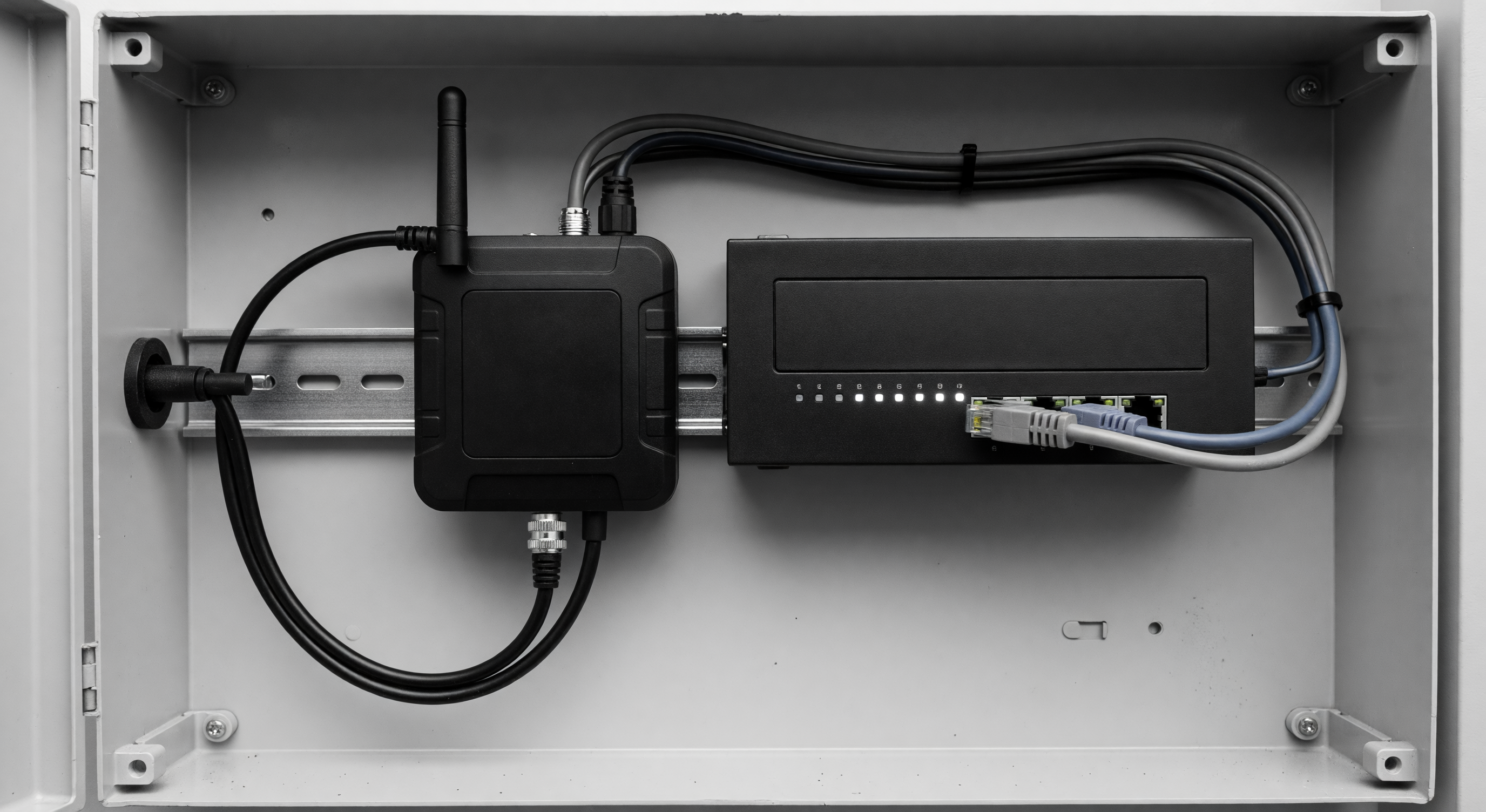
The connectivity choice for a barrier gate controller used to be simple: run conduit. That default broke a decade ago when cellular modems became cheap enough to deploy everywhere, and it has been shifting ever since. In 2025, the decision tree is genuinely nuanced — cellular is cheaper to install, hardwired is cheaper to operate, and the 3G/4G carrier sunset schedules create a timing dimension that did not exist before.
This is a decision operators make once per site and regret for ten years.
The Case for Cellular
Cellular wins on installation economics. A gate controller dropped into a lot far from a tenant building needs no trenching, no low-voltage contractor, and no coordination with IT. A technician installs the modem, activates the SIM, and the gate is online in an hour.
This matters most in three scenarios:
- Distant lanes — airport remote lots, university overflow lots, event parking — where trenching runs thousands of dollars per lane
- Temporary or transitional sites where infrastructure investment cannot be justified
- Retrofit projects where running new cable through occupied concrete or across active roadways is disruptive
Per-site install savings commonly run $2,000 to $8,000 versus a proper hardwired drop.
The Case for Hardwired
Operating cost is where hardwired wins. A cellular data plan for a typical gate controller runs $15 to $35 per month with a private APN. Over a 10-year asset life, that is $1,800 to $4,200 per gate in recurring cost — more than the cost of a modest trenched drop on most sites.
Hardwired also wins on latency and reliability for integrations. A gate controller that needs to hit a LPR camera, a pay station, and a cloud API in sequence completes those transactions faster over a local LAN than over cellular. In high-throughput lanes, the difference is measurable — cellular round-trip times of 80 to 200 ms versus 5 to 20 ms on wired.
Outage patterns differ too. Cellular goes down in region-scale carrier events (tower maintenance, severe weather, upstream fiber cuts). Wired goes down in site-scale events (ISP outage, cable damage). Neither is strictly more reliable, but the failure modes are different and planning accordingly matters.
The 3G/4G Sunset Problem
This is the timing dimension. North American carriers completed 3G shutdown in 2022. 4G LTE will follow, with AT&T and Verizon already announcing LTE deprecation timelines for specific bands between 2028 and 2032. Gate controllers deployed today with 4G-only modems will be stranded within this asset’s planned life.
The practical implication: any new cellular deployment should use 5G-capable modems, or at minimum LTE CAT-M1 / NB-IoT modems that fall under carrier long-term support commitments for IoT devices. Consumer-grade LTE modems are a procurement mistake in gate applications.
The FCC maintains current carrier sunset information, and industry trackers published by IoT platform vendors track per-carrier band deprecation in detail.
The Decision Matrix
| Factor | Cellular | Hardwired |
|---|---|---|
| Install cost | Low ($200-$600 incremental) | High ($1,500-$8,000) |
| Monthly recurring | $15-$35 | $0 (on existing internet) |
| Install time | Hours | Days to weeks |
| Latency | 80-200 ms | 5-20 ms |
| Bandwidth | 1-10 Mbps typical | 10-1000+ Mbps |
| Reliability failure mode | Regional carrier events | Site-local ISP / cable |
| Maintenance access during ISP outage | Works | Fails |
| 10-year TCO (typical) | $2,500-$5,500 | $1,800-$9,000 |
The TCO math flips at different points depending on trenching distance. Sites under 150 feet from existing network gear usually favor hardwired; sites over 400 feet usually favor cellular; the middle range depends on site conditions.
Hybrid: Primary Wired, Cellular Failover
The best-of-both option is a hybrid — hardwired primary for day-to-day performance, cellular failover for resilience when the site ISP goes down. Modern industrial routers from Cradlepoint, Digi, or Sierra Wireless handle this seamlessly with dual-WAN failover logic.
Hybrid adds roughly $400 to $700 to site BOM and a low monthly data fee (cellular consumes only in failover), so it is economically defensible for operators who cannot tolerate any cloud-connected downtime — notably pay-on-foot facilities where cloud payment processing must stay live.
Security Implications
Both connectivity modes have security footprints, but different ones:
- Cellular deployments should use a private APN with IPSec tunneling back to the operator VPN. Public-internet-exposed cellular gate controllers have been compromised, used for crypto mining, and ransomed.
- Hardwired deployments must be VLAN-isolated from any building tenant network. A gate controller on the same broadcast domain as a retail tenant’s POS is a compliance and liability problem.
The Cybersecurity and Infrastructure Security Agency publishes guidance on OT/IT segmentation that applies directly to gate controllers treated as operational technology.
What Manufacturers Recommend
Most major gate manufacturers — including CAME, FAAC, Nice, HUB, Magnetic Autocontrol, and BFT — now ship controllers with optional cellular modules and expect IP-based management. The reference architectures vary, but the shared pattern is: hybrid where possible, cellular where hybrid is not economic, hardwired where cellular data costs would exceed trenching.
A useful habit in procurement: require the vendor to specify the modem’s cellular band certifications, carrier approvals, and end-of-support date. “4G capable” is not an adequate spec.
FAQ
Is Wi-Fi a valid third option?
Rarely. Consumer Wi-Fi is not reliable enough for critical infrastructure, and even enterprise Wi-Fi adds variability. Industrial Wi-Fi with site-controlled access points is defensible in covered garages but almost never preferred over wired for a stationary device.
What about LoRaWAN or other low-power networks?
Fine for telemetry-only use cases (cycle counting, fault reporting) but inadequate for control integration, LPR camera streaming, or cloud payment transactions. These narrow-band networks do not carry the throughput a modern gate ecosystem demands.
Does cellular affect how fast the arm goes up?
No. The arm cycle is controlled locally by the gate controller. Cellular latency affects cloud-based credential lookups (LPR plate verification, token-based mobile access) and remote management, not the physical operation of the arm.
Are Starlink or other satellite services an option now?
Starting to be, particularly for very remote sites. Latency on LEO satellite services runs 25 to 60 ms — competitive with wired — and coverage is now continental. Cost remains higher than cellular for fixed installations, so the use case is primarily where cellular coverage is poor or absent.
Hero image: “Arany Insel, Schranke, 2021 Csongrád” by Globetrotter19, CC BY-SA 3.0, via Wikimedia Commons (https://commons.wikimedia.org/wiki/File:Arany_Insel,_Schranke,_2021_Csongr%C3%A1d.jpg).
)