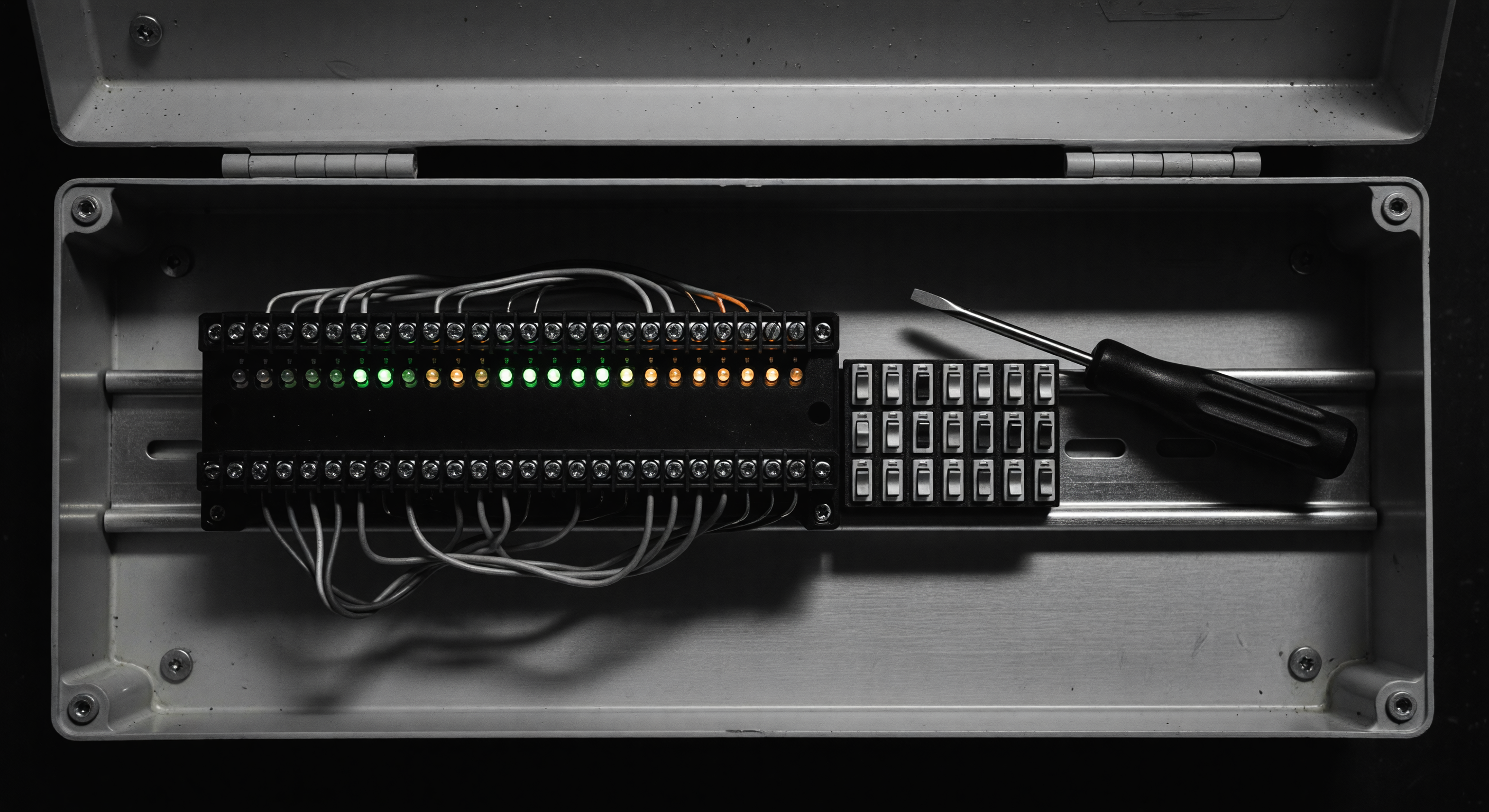
Most barrier gate nuisance faults — gates closing on vehicles, failing to open for trailers, or refusing to reset — trace back to detector timing, not detector hardware. The inductive loop itself is almost indestructible; the logic that interprets its signal is what drifts, miscalibrates, or gets left on factory defaults long after site conditions have changed.
Correctly configuring presence mode, pulse mode, hold-open timers, and sensitivity requires understanding what each parameter does and how they interact during a cycle.
Presence vs pulse: two different jobs
Loop detectors operate in two fundamentally different output modes:
Presence mode. The output remains active as long as a vehicle is over the loop. Presence is used for safety loops — typically the loop directly under the arm — where the gate must not close while a vehicle is present. Presence output is continuous and drops only when the loop returns to its tuned baseline.
Pulse mode. The output triggers once when a vehicle enters the loop (or exits, depending on edge selection), then resets. Pulse is used for free-exit loops, vehicle counting, and triggering gate-open commands where continuous output would cause problems.
A single physical loop can often be configured in either mode, but the two modes serve distinct functions. Using presence output for a free-exit trigger on a detector without a reset timer will cause the gate to stay open as long as any vehicle remains on the loop — including during a traffic backup.
The three loops of a typical barrier gate
A correctly laid-out single-lane exit barrier has three loops:
- Arming / free-exit loop — triggers gate-open command. Pulse mode on leading edge.
- Safety loop — under the arm. Presence mode. Prevents closure.
- Closing / reset loop — downstream of the arm. Pulse mode on trailing edge, triggers close after the vehicle clears.
Omitting the closing loop and relying on a timer to close the gate is a frequent shortcut that creates tailgating exposure. Omitting the safety loop is a code violation in most jurisdictions under UL 325 and ASTM F2200 — a gate closing on a vehicle because the safety loop was disabled is one of the higher-liability failures in the industry.
Sensitivity settings and how they drift
Loop detectors measure inductance changes as metal mass enters the loop field. Sensitivity is typically adjustable across 4-8 levels:
- Level 1 (least sensitive) — detects cars reliably, may miss bicycles and some small trailers with limited metal mass.
- Level 4-5 (medium) — most common setting. Detects cars, small trucks, motorcycles with metal frames.
- Level 8 (most sensitive) — can detect bicycles, lawn equipment, some pedestrian carts. Prone to false triggers from rebar in adjacent slabs, rail cars passing within 10 m, electrical noise.
Detectors self-tune their baseline on power-up. Over time, environmental drift — temperature, ground moisture, corrosion on loop splices — pushes the baseline. Most detectors compensate automatically, but a badly corroded splice will eventually push past the compensation range and cause permanent false-present conditions, freezing the gate open.
Hold-open timing
Hold-open time — how long the gate stays raised after the vehicle clears — is usually set between 2 and 8 seconds. Calibration considerations:
- Too short: gate starts to descend while slower vehicles (trucks, vehicles with trailers) are still under the arm. Safety loop catches it but the gate “hunts.”
- Too long: tailgating window. Second vehicle slips through without a transaction.
- Site-specific: a hospital patient drop-off lane reasonably uses 8+ seconds; a transit park-and-ride exit lane uses 2-3 seconds.
When a site reports repeated tailgating issues, hold-open timing is the first parameter to audit — often it was increased years earlier to fix a symptom and never reset.
Calibration procedure
A defensible quarterly calibration check:
- Verify loop resistance and inductance are within manufacturer spec at the detector terminals.
- Confirm detector self-test indicates no fault.
- Drive a reference vehicle across each loop. Confirm output LEDs activate cleanly (no chatter).
- Test with a motorcycle or bicycle if those are expected users.
- Time hold-open against a stopwatch. Adjust if drifted from spec.
- Test safety loop with a static obstruction (cone) — gate must not close.
- Log readings for trending.
Trending is the undervalued practice. A loop whose baseline inductance has drifted 15% over six months is months away from a splice failure.
Frequently Asked Questions
What’s the difference between a safety loop and an obstruction detector?
A safety loop is an inductive loop in the pavement monitored by the gate controller. An obstruction detector uses photo beams or reaction forces. Both are valid; most commercial installs use both for redundancy per UL 325 guidance.
Why does my gate intermittently fail to detect bicycles?
Bicycles have limited metal mass. Either raise detector sensitivity one level, add a secondary loop configured for bicycle detection, or use a photo beam as the trigger in mixed-use lanes.
How often should loops be recalibrated?
Detector electronics self-tune continuously. Manual verification quarterly is reasonable. Full loop resistance and insulation-to-ground testing annually catches splice degradation before it causes outages.
Can one loop serve as both arming and safety loop?
No. Arming is typically pulse-on-entry; safety is presence. They serve different logic paths and must be separately configured, though modern detectors can run two channels from one physical loop in limited cases.