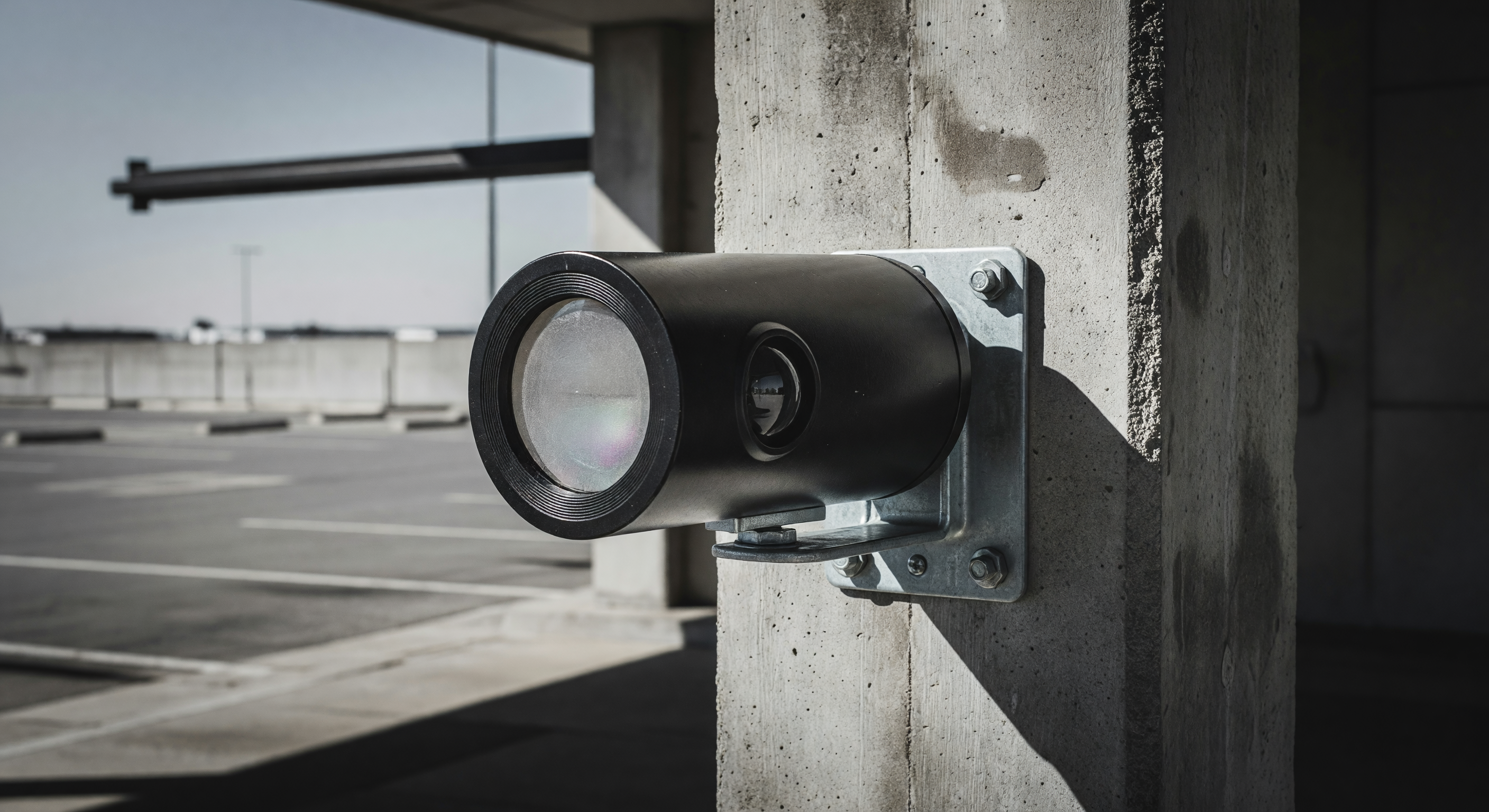
UL 325 does not let you pick one. Every automatic vehicular gate operator sold in North America after 2016 is required to have two independent means of entrapment protection per entrapment zone — the so-called “Type B” redundancy. Installers who specify a single device, or two devices of the same type, are creating a compliance problem that will surface the first time an insurance adjuster or inspector asks.
The practical question is which two devices to pair. Photo beams and contact safety edges are the two dominant technologies, and they have very different failure modes. That is why the standard rewards combining them.
What UL 325 Actually Requires
UL 325 defines four entrapment protection device types: A (inherent motor sensing), B1 (non-contact — photo eyes), B2 (contact — safety edges), and D (constant pressure hold-to-run). Every primary entrapment zone on a barrier gate requires two different-type devices, monitored such that failure of either device prevents automatic operation.
For barrier arms, the primary entrapment zones are the descent path under the arm and the crush point between the arm tip and any adjacent structure. Secondary zones exist on housings with pinch points.
The redundancy rule matters because both technologies have blind spots. A photo eye fouled by a spider web loses detection capability silently. A contact edge crushed flat by an earlier impact loses activation pressure. Pairing them means the failure modes are independent.
Photo Beams: Strengths and Limits
Photo beams — typically infrared through-beam or retroreflective — detect presence before contact. That is their fundamental advantage. A vehicle or pedestrian breaks the beam well before the arm touches anything.
Good specs to look for:
- Monitored pair with self-diagnostics that report fault to the operator controller
- Range margin of 2x the installed distance to tolerate fog, rain, and alignment drift
- Hard-wired rather than battery-powered — batteries die and alignment suffers on housing-mounted designs
- Polarized retroreflective if using a single-sided setup, to reject false returns from shiny vehicles
Failure modes to design around: lens fouling (bugs, snow, road grime), sun blinding at sunrise/sunset on east-west lanes, misalignment from housing vibration, and occluded lower detection — a photo eye mounted at 24 inches will not see a toddler’s foot on the ground.
Contact Safety Edges: The Last Line
A safety edge is a compressible rubber or polymer strip with an embedded conductive sensor — pneumatic, resistive, or optical. Compression triggers an immediate reverse of the gate. Edges are mounted on the leading edge of the gate arm itself, and sometimes along the housing on either side of the arm swing path.
Edges are simpler than beams and cheaper per device, but they only activate on contact — by definition, after something has touched the arm. That is the price of contact detection: a user gets a bump before the gate reverses. For a 400-pound barrier arm at full descent speed, that bump is benign for a vehicle, not benign for a pedestrian.
Selection criteria:
- Pneumatic hose edges (the traditional Miller edge style) are inexpensive but lose sensitivity at low temperatures
- Resistive edges (the newer 8.2 kΩ standard) self-monitor via the end-of-line resistor and are preferred for UL 325 B2 compliance
- Optical edges offer the best sensitivity but at 3x to 4x the cost
- Length must cover the entire leading edge from hinge to tip
Mounting matters more than the edge itself. A rigidly-mounted edge on a rigid arm gives narrow activation pressure. Proper specification includes an aluminum channel with rubber cushioning so the edge can compress properly.
The Pairing That Works
For a standard single-lane barrier gate, the reliable pairing is:
- Dual photo beams at arm tip height (roughly 30 inches) covering the descent path, wired as a monitored pair
- Resistive contact edge along the full leading edge of the arm, terminated with an 8.2 kΩ end-of-line resistor at a monitored input on the controller
This combination satisfies UL 325’s different-device-type requirement, covers both presence detection and contact detection, and degrades gracefully — if the beam goes blind in fog, the edge still works, and vice versa.
Skip these common mistakes:
- Two photo eyes at different heights does not satisfy the different-type rule; both are Type B1
- Inherent motor sensing alone counts as Type A and can pair with a B-type, but relying only on Type A is marginal for 12-foot arms with high inertia
- Unmonitored edges — if the controller cannot detect a broken wire or missing resistor, the edge does not count toward compliance
Installation and Testing Cadence
Entrapment devices are not install-and-forget. The American Fence Association and most operator manufacturers recommend monthly functional testing: interrupt each beam during descent, compress the edge during descent, confirm the gate reverses and reports the event.
Document every test. Insurance claims following gate-related injuries routinely demand device test logs going back years.
FAQ
Is inherent motor sensing enough on its own?
No. UL 325 requires two independent means of entrapment protection per primary zone. Motor sensing (Type A) can be one of them, but it must be paired with a B-type or D-type device. Many commercial installations skip Type A entirely and use B1 + B2 instead, because motor sensing calibration drifts.
Can one photo beam cover both sides of the arm?
Some installations use a single through-beam spanning the full roadway width. That is acceptable if the beam is positioned to cover the full descent path, but a dual-side arrangement with two monitored pairs is more reliable and avoids sunrise blinding.
How often do safety edges actually fail?
Pneumatic edges degrade measurably every year from UV exposure, especially above 30° latitude. Expect a 5 to 7 year service life on hose edges, 8 to 12 years on resistive. Any visible cracking, flattening, or loss of rebound means replacement.
Does the same logic apply to swing and sliding gates?
Yes. UL 325 covers all four operator classes, and the entrapment protection requirements apply broadly. Swing and sliding gates have more entrapment zones (hinge points, bottom of the leaf, side of the leaf near the post) so the device count climbs.