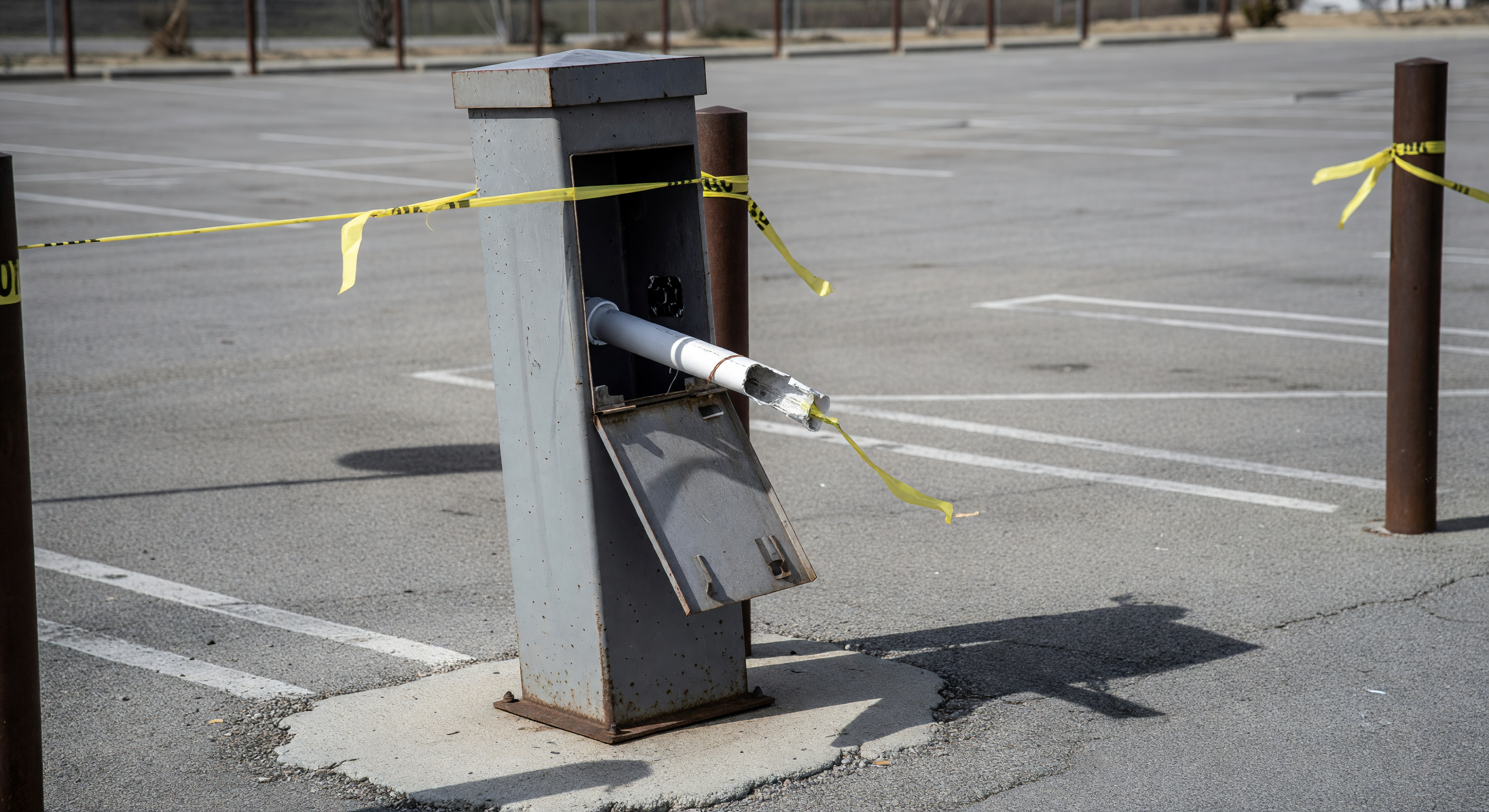
Copper theft at gate installations is not a rare event. LME copper prices have sustained a range that makes even small gate runs economically attractive to thieves — a typical barrier gate site contains $150 to $600 of recoverable copper in power feeds, loop wiring, and control cabling. Organized theft crews hit several sites in a night and are gone before anyone notices the gate is inoperative.
Insurance carriers increasingly price policies around copper theft exposure, and facilities with repeated losses see coverage tightening or being declined. Mitigation is cheap relative to recovery; the cost-benefit math favors prevention at specification time.
Where Copper Gets Stolen
Three zones account for most losses at gate sites:
- Power feed from the pedestal to the main electrical panel — typically buried or in conduit, often the largest wire gauge on site (and therefore the highest-value target)
- Loop leads from the sawcut to the controller — smaller gauge but exposed at both ends
- Control cabling between gate housing and pay station, LPR camera, or remote receiver — multi-conductor runs, surprisingly valuable in bulk
Thieves target the power feed first because gauge and length combine to maximize value per trip. Loops and control cabling are opportunistic secondary targets.
Specification-Level Defenses
Most of the mitigation work happens at design time, before any wire goes in the ground. Retrofit hardening is possible but expensive.
Rigid Conduit vs Flexible
Schedule 40 PVC is the default for buried electrical, and it is exactly what copper thieves exploit — PVC conduit can be cut with a hand saw in under a minute, exposing the cable inside. Schedule 80 PVC is slightly harder to cut but still not meaningful protection.
Galvanized rigid metal conduit (RMC) and intermediate metal conduit (IMC) are dramatically more theft-resistant. A portable reciprocating saw will still cut them, but loudly and slowly enough that opportunistic theft becomes unattractive. The cost premium over PVC is roughly 2x to 3x for materials and 1.5x for labor.
For high-risk sites — unattended lots, sites with prior theft incidents, urban locations — RMC or IMC is the defensible specification. For lower-risk sites (actively monitored, within a gated perimeter), schedule 80 PVC with other mitigations may be adequate.
Concrete Encasement
Burying conduit in concrete — either by pouring a concrete-encased duct bank or by using precast concrete trench — moves theft from a one-person hand-tool job to a crew with a jackhammer. The deterrent effect is substantial.
Code requires this for some applications already (NEC 300.5 for certain direct-burial conditions), and specifying concrete encasement for gate power feeds adds typically $8 to $20 per linear foot over straight direct burial. Worth it on any site with significant exposed footage.
Cable Selection
Some operators specify aluminum rather than copper for the power feed in high-risk sites. Aluminum scrap has 1/4 to 1/5 the resale value of copper per pound, reducing the theft incentive. Aluminum requires larger gauge for equivalent ampacity and proper anti-oxidant treatment at terminations, but the tradeoff is defensible for power runs in repeat-theft areas.
Loop wire is a harder problem — loops must be copper, and the lead length from the sawcut to the controller is a vulnerability. Some designs run loop leads through rigid conduit for the exposed portion, which helps.
Physical Deterrents at the Gate
At the gate pedestal itself:
- Tamper-resistant fasteners on housing access panels — Torx security, one-way screws, or proprietary socket patterns
- Intrusion switches on housing doors, wired to the alarm system
- Potting of critical terminal strips with epoxy — makes field rework harder but also makes unauthorized access slower and messier
- External conduit shielded with steel riser guards up to the pedestal
None of these individually stops a determined thief. Collectively they push the required effort high enough that the site becomes unattractive compared to easier targets nearby.
Monitored Alarming
Detection matters because copper thieves usually operate when nobody is watching. Three approaches:
Loss-of-loop detection. Any properly-configured gate controller reports loop failure as a fault. An alarm condition triggered within seconds of a loop being cut notifies the operator in real time. Response times under 10 minutes have caught theft crews on multiple sites.
Power-loss monitoring. A UPS-backed controller that reports mains loss immediately distinguishes a cut power feed from a scheduled outage. Cellular-backup connectivity ensures the alert goes out even when site power is gone.
Cable-integrity monitoring. More sophisticated systems loop a monitoring conductor through all critical cable runs. A break anywhere in the monitored loop triggers an alarm. Relatively few parking-specific controllers support this natively, but industrial site-monitoring platforms do.
The American Parking Association has published loss-prevention guidance specific to parking facilities, and insurance carriers increasingly request evidence of alarming on sites seeking coverage in urban markets.
Site Design and Lighting
A few environmental factors substantially affect theft rates:
- Lighting on the gate pedestal, pay station, and any exposed conduit runs. LED flood lighting is cheap and highly deterrent.
- Camera coverage that captures the gate and approaches. Even visible dummy cameras (ideally paired with real ones) deter opportunistic theft.
- Sightlines from neighboring occupied buildings. Sites tucked behind retail buildings or below grade are disproportionately targeted.
- Vegetation around pedestals — dense landscaping provides cover for theft activity.
None of these is expensive compared to hardened conduit, and the interaction effect with other deterrents is significant.
Insurance and Documentation
Post-incident recovery depends on documentation. A few habits that pay off:
- Keep the original installation drawings showing conduit paths, cable specs, and terminations
- Photograph the installed site at commissioning — serves as baseline for damage assessment
- Log every service visit and note any signs of tampering, regardless of whether theft occurred
- Review insurance policy language for copper theft specifically — some policies carve out or limit coverage
After a theft event, document everything before any cleanup. Copper theft scenes often have forensic evidence that leads to prosecution when the crew is caught hitting a later site.
What Does Not Work
- Warning signs alone. Signage without physical deterrent is ignored.
- Paint marking of cable. Some utilities paint cable with theft-deterrent paint that is visible when sold to recyclers. Limited effectiveness in parking applications because the wire runs are short and easily stripped.
- Cut-resistant jacketing. Marginally slows cut time; does not change the fundamental economics.
FAQ
How much does a theft event actually cost?
The repair bill typically runs 3x to 8x the scrap value of the stolen copper. Trenching, rewiring, traffic control during work, and the gate downtime itself all add up. A single event on a typical site commonly exceeds $5,000 in restoration costs.
Does anti-theft wire work?
Products like steel-clad wire and armored cable exist. They are defensible for exposed feeder runs but overkill for most parking applications. The cost premium rarely justifies the marginal deterrent above good conduit.
Is LED lighting enough to deter theft?
It helps substantially but is not a full solution. LED lighting with motion-activated alarm triggering is more effective than steady lighting because the change-of-state itself is a deterrent.
What about sites with repeat incidents?
Sites hit more than twice in 24 months need a step-change in hardening — either RMC with concrete encasement, a monitored alarm system, or camera coverage with verified response. Doing the same thing after three incidents is just budgeting for the fourth.