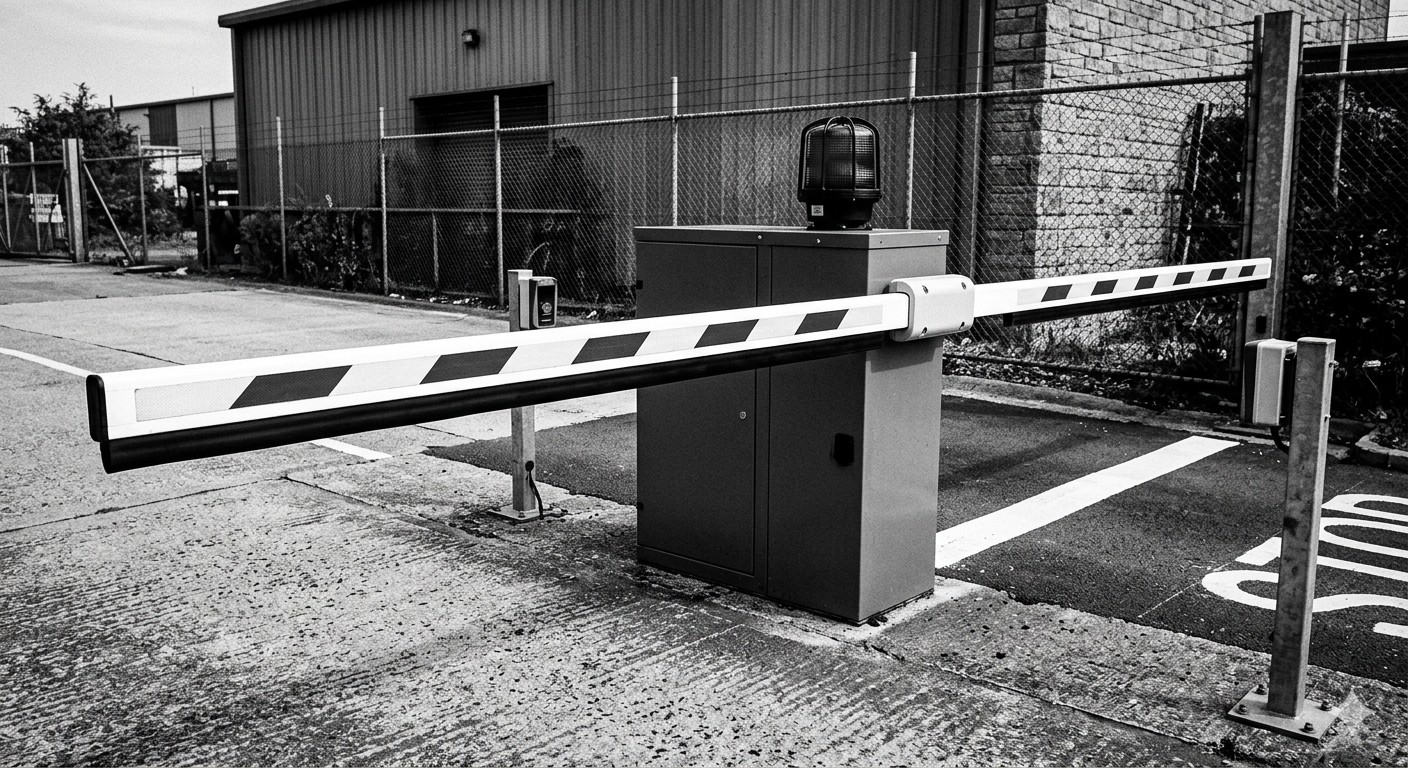
Barrier gates are powerful mechanical devices that move heavy arms at speed across vehicle and pedestrian pathways. When properly installed and maintained, they operate safely for millions of cycles. When safety standards are ignored – because of budget pressure, ignorance, or corner-cutting during installation – the consequences can be severe: injuries, lawsuits, regulatory fines, and in extreme cases, fatalities.
This article covers the primary safety standards and compliance requirements that apply to barrier gate systems in North America. Whether you are a facility operator, an installer, or a procurement decision-maker, understanding these standards is not optional – it is a fundamental part of responsible gate ownership.
The Regulatory Landscape
Barrier gate safety is governed by a layered framework of federal, state, and industry standards. No single document covers everything. Operators must navigate multiple overlapping requirements.
The four pillars of barrier gate safety compliance are:
- UL 325 – Product safety standard for gate operators
- ASTM F2200 – Performance standard for automated vehicular gates
- ADA – Accessibility requirements
- OSHA – Workplace safety obligations
Each addresses different aspects of safety, and compliance with one does not guarantee compliance with the others.
UL 325: The Foundation Standard
What It Is
UL 325 is the safety standard published by Underwriters Laboratories for door, gate, window, and louver operators and systems. It is the single most important safety standard for barrier gate installations in the United States and is widely referenced in Canada as well.
UL 325 classifies gate operators into four classes based on the type of gate and its usage:
| UL 325 Class | Gate Type | Typical Application |
|---|---|---|
| Class I | Residential | Single-family homes, limited access |
| Class II | Commercial/General Access | Parking facilities, office complexes |
| Class III | Industrial/Limited Access | Warehouses, factories, restricted areas |
| Class IV | Residential/Commercial (vehicular barrier) | Parking barrier arms, boom gates |
Barrier gates in parking applications fall under Class IV. This classification has specific requirements for entrapment protection, safety devices, and operational behavior.
Key UL 325 Requirements for Barrier Gates (Class IV)
- Entrapment protection: The gate system must include devices that detect the presence of a person or vehicle in the path of the moving arm. Upon detection, the arm must stop and reverse.
- Primary entrapment protection device: At minimum, one inherent entrapment protection device (such as an obstruction-sensing mechanism that monitors motor current or arm force) must be present.
- External entrapment protection devices: Additional devices such as photo eyes, presence-sensing loops, or safety edges are required depending on the installation configuration.
- Manual release: A means to manually release and operate the gate arm in case of power failure or system malfunction must be provided and be accessible.
- Labeling and marking: The gate operator must carry the UL 325 listing mark, and installation instructions must specify the required safety devices and their placement.
- Monthly operational testing: UL 325 recommends (and many jurisdictions require) monthly testing of all safety devices to verify proper operation.
Why UL 325 Compliance Matters
Many local building codes and jurisdictions reference UL 325 directly. If a barrier gate is installed without UL 325-listed equipment and proper safety devices, the operator may face:
- Failure to pass building inspection
- Denial of occupancy permits
- Increased liability in the event of an accident
- Insurance coverage issues
All major barrier gate manufacturers – CAME, FAAC, Magnetic Autocontrol, Nice/Hi-Speed, Parking BOXX, and others – produce UL 325-listed operators for their barrier gate product lines. However, the listing applies to the complete installed system, not just the gate hardware. An improperly installed UL 325-listed gate is not a compliant gate.
ASTM F2200: Gate Construction and Performance
What It Is
ASTM F2200 is the standard specification for automated vehicular gates published by ASTM International (formerly the American Society for Testing and Materials). While UL 325 focuses on the gate operator and its safety devices, ASTM F2200 addresses the gate structure itself, including design, materials, and performance.
Key ASTM F2200 Requirements
- Structural integrity: The gate and its supporting structure must withstand the forces generated during normal operation, including wind loads, the weight of the arm, and the forces applied during opening and closing.
- Entrapment zones: The standard identifies specific zones around the gate where entrapment risks exist and requires that these zones be addressed through design or safety devices.
- Arm or gate component failure: The standard addresses what happens if a gate component fails (arm breakage, mounting failure) and requires that such failures not create additional hazards.
- Installation instructions: Manufacturers must provide clear instructions that address site-specific safety considerations.
ASTM F2200 Entrapment Zones
ASTM F2200 defines four entrapment zones that must be evaluated for every barrier gate installation:
| Zone | Location | Risk | Typical Mitigation |
|---|---|---|---|
| Zone 1 | Between the leading edge of the arm and any fixed object | Crushing/pinching | Safety edge on arm, photo eyes |
| Zone 2 | Between the bottom of the arm and the ground/road surface | Striking pedestrians/cyclists | Photo eyes, presence loops |
| Zone 3 | Between the arm and the gate housing/post | Pinching at pivot point | Guards, covers, restricted access |
| Zone 4 | Between any moving component and an adjacent fixed structure | Crushing | Physical guards, spacing requirements |
Each zone must be protected by either physical barriers (guards, spacing) or active safety devices (sensors, photo eyes, safety edges). The zone analysis is site-specific – what works at one installation may not be adequate at another.
ADA Compliance
What It Requires
The Americans with Disabilities Act (ADA) and its accompanying design standards apply to barrier gate installations at any facility that serves the public or employs workers.
ADA requirements relevant to barrier gates include:
- Accessible routes: Pedestrian paths that cross or run adjacent to gate lanes must maintain required clear widths and not be obstructed by the gate or its peripherals.
- Reach ranges: Card readers, ticket dispensers, intercoms, and payment devices must be mounted within the specified reach ranges for persons with disabilities. Typically, the operable parts of controls must be between 15 and 48 inches above the floor surface.
- Protruding objects: The barrier arm, when in the raised position, must not create a protruding object hazard for persons with visual impairments if it extends over a pedestrian path.
- Accessible parking: The barrier gate must not impede access to or from designated accessible parking spaces, and the accessible route from those spaces to the facility entrance must be maintained.
Common ADA Violations at Barrier Gates
These violations are found repeatedly during facility audits:
- Card reader or intercom mounted too high: Drivers in accessible vehicles with hand controls or modified driving positions cannot reach devices mounted at standard car-window height. Dual-height mounting or alternative access methods are required.
- Pedestrian path blocked: A gate island that forces pedestrians into the vehicle lane to get around it violates accessible route requirements.
- No pedestrian bypass: Facilities that require all entry through a gated vehicle lane without providing a separate pedestrian entrance fail ADA requirements.
- Signage obscured: Required accessible parking and wayfinding signage is hidden behind gate equipment.
OSHA: Workplace Safety
Employer Obligations
The Occupational Safety and Health Administration (OSHA) does not have a specific standard for barrier gates, but the General Duty Clause (Section 5(a)(1) of the OSH Act) requires employers to provide a workplace free from recognized hazards.
For barrier gates, this means:
- Hazard assessment: Employers must identify and mitigate hazards associated with barrier gates on their property. This includes risks to employees who walk, drive, or work near the gates.
- Training: Employees who operate, maintain, or interact with barrier gates must receive training on safe operation, emergency procedures, and the location of manual release mechanisms.
- Lockout/tagout (LOTO): Maintenance personnel working on barrier gate mechanisms must follow LOTO procedures (OSHA 29 CFR 1910.147) to ensure the gate cannot be activated while being serviced.
- Recordkeeping: Injuries involving barrier gates must be recorded on the OSHA 300 log if they meet reporting thresholds.
OSHA-Related Best Practices
| Practice | Description | OSHA Relevance |
|---|---|---|
| Written safety plan | Document gate hazards, mitigation measures, and emergency procedures | Demonstrates compliance with General Duty Clause |
| Regular safety audits | Inspect gates monthly for safety device function | Proactive hazard identification |
| Employee training | Annual training on gate safety and emergency release | Required under General Duty Clause |
| LOTO procedures | Written procedures for maintenance lockout | Required under 29 CFR 1910.147 |
| Incident investigation | Investigate and document all gate-related incidents | Supports OSHA 300 log compliance |
Fire Code and Emergency Access
Local fire codes impose additional requirements on barrier gates:
- Emergency vehicle access: Barrier gates on fire lanes or providing fire department access must be equipped with emergency preemption systems (Opticom/GPS-triggered, Knox box manual override, or fire department radio-controlled).
- Fail-open vs. fail-closed: Most fire codes require gates on emergency access routes to default to the open position during power failure. This conflicts with security requirements, so the solution must be coordinated between the fire marshal and the facility operator.
- Gate opening time: Fire codes may specify maximum acceptable gate opening times for emergency access lanes. Verify that the selected barrier gate meets these requirements.
- Knox box or key switch: Many jurisdictions require a Knox box or keyed override switch accessible to fire department personnel at all barrier gate locations.
Building a Compliance Program
Compliance is not a one-time event. It’s an ongoing program that requires attention at four stages:
1. Specification and Procurement
- Require UL 325 listing for all barrier gate operators
- Specify ASTM F2200 compliance for gate structures
- Include ADA reach range and accessible route requirements in the project specification
- Verify that the manufacturer’s installation manual addresses all four ASTM entrapment zones
2. Installation
- Ensure the installer is familiar with UL 325, ASTM F2200, and local codes
- Verify proper placement and wiring of all safety devices before commissioning
- Conduct a site-specific entrapment zone analysis
- Document the installation with photos and a compliance checklist
- Obtain required permits and schedule inspections
For a step-by-step installation planning guide, see our barrier gate installation site assessment checklist.
3. Commissioning and Acceptance Testing
Before accepting an installation, perform and document the following tests:
| Test | Pass Criteria | Frequency |
|---|---|---|
| Entrapment reversal | Arm reverses within 2 seconds of contacting test object | Commissioning + monthly |
| Photo eye function | Arm stops and reverses when beam is broken | Commissioning + monthly |
| Loop detector function | Arm does not close while vehicle is present on loop | Commissioning + monthly |
| Manual release | Arm can be manually raised and lowered by one person | Commissioning + monthly |
| Emergency preemption | Gate opens within required time when preemption is triggered | Commissioning + quarterly |
| Power failure behavior | Gate assumes correct fail-safe position | Commissioning + annually |
4. Ongoing Maintenance and Documentation
- Maintain a safety device testing log with dates, results, and tester identity
- Schedule monthly safety device inspections aligned with UL 325 recommendations
- Retrain personnel annually on gate safety and emergency procedures
- Update the compliance documentation whenever equipment is modified or replaced
- Retain records for the life of the installation plus the applicable statute of limitations
For detailed maintenance scheduling, see our barrier gate preventive maintenance guide.
Liability Considerations
Barrier gate operators should understand the liability chain:
- Manufacturer liability: The manufacturer is responsible for designing and producing a gate operator that meets UL 325 and other applicable standards when installed per their instructions.
- Installer liability: The installer is responsible for following manufacturer instructions, meeting local codes, and properly configuring safety devices.
- Owner/operator liability: The facility owner is responsible for maintaining the gate in a safe condition, conducting required inspections, and ensuring ongoing compliance.
If an injury occurs and the investigation reveals that safety devices were bypassed, maintenance was neglected, or the installation did not comply with applicable standards, liability typically falls on the party that failed in their obligation. This is why documentation at every stage is critical.
Common Compliance Failures
These are the most frequently cited compliance failures in barrier gate audits and accident investigations:
- Safety devices bypassed. Technicians disable photo eyes or loop detectors to “fix” nuisance trips, then forget to re-enable them. This is the single most common and most dangerous compliance failure.
- No monthly testing. UL 325 recommends monthly safety device testing. Many facilities have never tested their safety devices after initial commissioning.
- Missing or non-functional manual release. The manual release mechanism is locked, rusted, or inaccessible.
- Incorrect fail-safe mode. The gate fails closed on a fire lane, or fails open on a security perimeter, because the fail-safe mode was never configured for the specific application.
- No written safety plan. The facility has no documentation of gate hazards, testing schedules, or emergency procedures.
- Untrained personnel. Employees interact with gates daily but have never received safety training.
Key Takeaways
- UL 325 is the foundational safety standard for barrier gate operators. All commercial installations should use UL 325-listed equipment installed per manufacturer instructions.
- ASTM F2200 addresses gate construction and defines the four entrapment zones that must be evaluated and protected at every installation.
- ADA compliance is legally required and frequently violated. Pay particular attention to reach ranges, accessible routes, and pedestrian path obstructions.
- OSHA’s General Duty Clause requires employers to identify and mitigate barrier gate hazards, train employees, and follow lockout/tagout procedures during maintenance.
- Fire code requirements for emergency access, fail-safe positioning, and emergency preemption must be coordinated with the local fire marshal.
- Compliance is an ongoing program, not a one-time installation task. Monthly safety device testing, annual training, and continuous documentation are essential.
- When in doubt, consult the standards directly and engage qualified professionals. The cost of proper compliance is always less than the cost of a single serious incident.