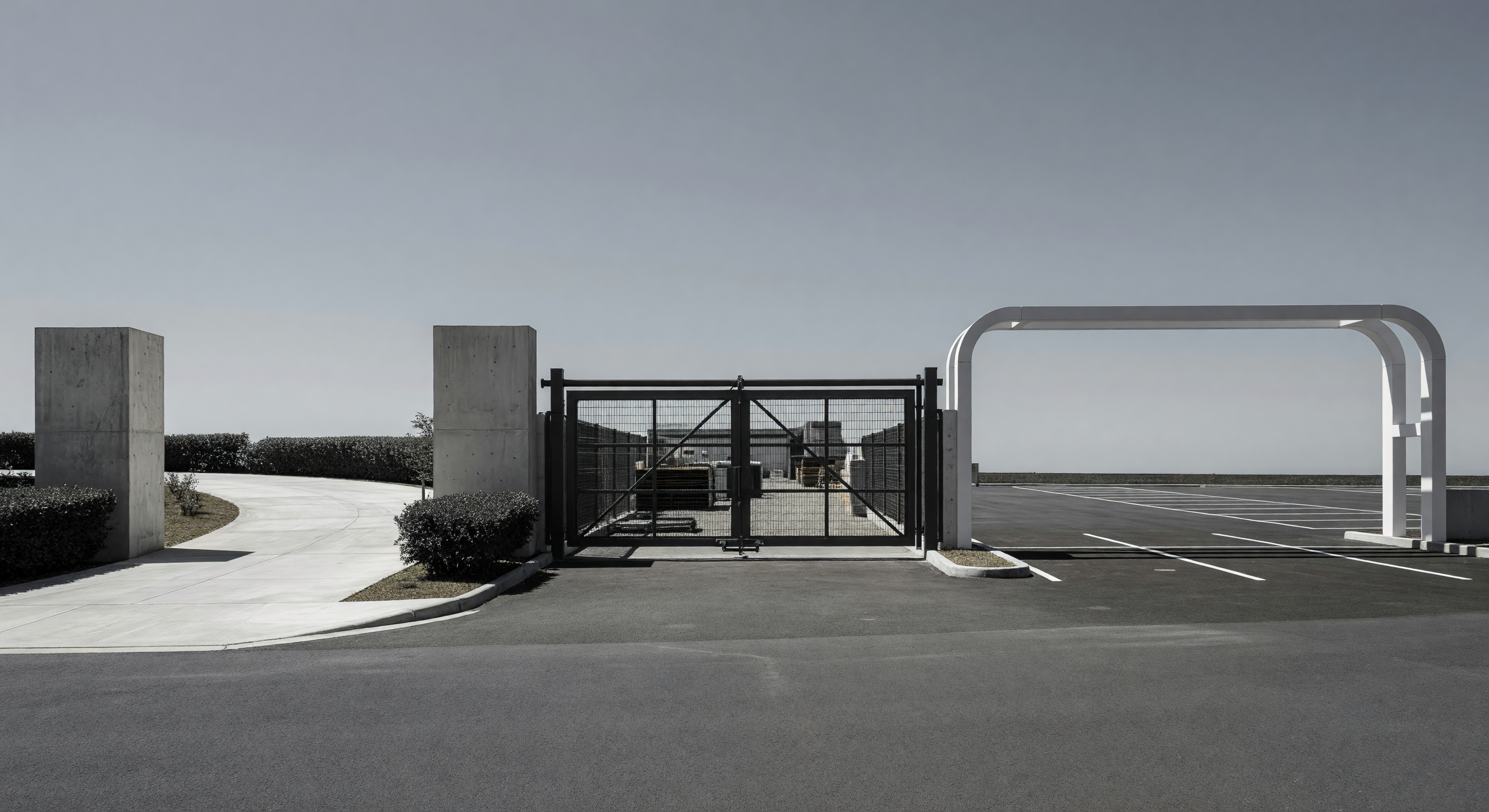
Every vehicle entry eventually forces the same decision: swing, slide, or barrier arm. The three designs solve overlapping problems but behave very differently under traffic, weather, and security load. Picking the wrong one is an expensive mistake — swing gates installed on tight driveways block lanes during every cycle, sliding gates on unlevel ground jump their tracks, and barrier arms posted at perimeters invite tailgaters.
This guide breaks down where each design earns its place and where it gets in the way.
Swing Gates: The Workhorse of Residential and Light Commercial
Swing gates are hinged vertical leaves — single or double — that rotate on vertical posts. They are the default for residential estates, small industrial yards, and any application where aesthetics and physical security both matter. A solid steel or ornamental aluminum leaf is genuinely hard to breach, unlike a barrier arm that snaps on impact.
The catch is swing radius. A 16-foot double-leaf gate requires roughly 8 feet of unobstructed arc inside or outside the property line. Driveways that grade uphill into the property cannot accommodate an inward-swing design, and narrow setbacks kill outward swings. UL 325 requires full entrapment protection zones across the arc, which means photo eyes or contact edges on both sides.
Cycle times run 12 to 20 seconds per open-and-close. That is fine for 30 vehicles a day, unacceptable for 300.
Sliding Gates: Perimeter Security at Scale
Cantilever sliding gates — the style with no bottom track — have displaced older V-track designs across most commercial and industrial applications. A cantilever gate stores parallel to the fence line, eliminates ground debris problems, and handles openings up to 40 feet without a center post.
Sliders shine where security is the primary spec. Combine a 6-foot anti-climb mesh leaf with barbed outriggers and you have a genuine deterrent, not just a credential check. The ASTM F2200 standard governs cantilever construction, and UL 325 Class III/IV operators handle the duty cycle.
Downsides are real. A 30-foot cantilever gate needs roughly 45 feet of side-yard storage length. The counterbalance extension doubles as a climbing ladder if not shrouded. And the operator chain is a known failure point — a properly maintained gate runs 5 to 7 years on the original chain, a neglected one replaces it annually.
Barrier Gates: Throughput Over Security
Barrier gates — the horizontal arm mounted to a vertical housing — are not security devices. An arm exists to regulate traffic flow, authenticate access, and count vehicles, not to stop a determined driver. Any standard barrier arm will break off under roughly 200 to 400 pounds of horizontal force, which is by design — breakaway preserves the mechanism when inevitable collisions happen.
Where barriers dominate is throughput. A high-speed barrier from manufacturers like Magnetic Autocontrol, FAAC, or HUB can cycle in under 1.3 seconds, moving 1,500-plus vehicles per hour through a single lane. Parking garages, toll plazas, and employee lots live or die on that number. No swing or slide gate approaches it.
Barriers also integrate cleanly with LPR cameras, RFID readers, ticket dispensers, and pay stations. The ecosystem of compatible access control hardware is far deeper than for swing or slide operators.
The Decision Matrix
| Factor | Swing | Sliding | Barrier |
|---|---|---|---|
| Throughput (vehicles/hour) | 150-250 | 200-400 | 800-1,500+ |
| Physical security | Moderate-High | High | None (traffic control only) |
| Site space required | Swing arc | Side-yard storage | Minimal |
| Typical cycle time | 12-20 sec | 10-15 sec | 1.3-6 sec |
| Storm resilience | Good | Good | Arm damage in 80+ mph winds |
| Ballpark installed cost | $6K-$15K | $10K-$25K | $5K-$18K |
The pattern: security-first perimeters use swing or slide; throughput-first lanes use barriers. Hybrid sites often combine them — a sliding gate after hours, barrier arms during business hours.
Common Mistakes
Three specification errors we see repeatedly:
- Swing gates on commercial sites with delivery trucks. Air-brake semi-trailers cannot reliably stop within swing arcs. The resulting impact damage is frequent and expensive.
- Barrier arms specified where bollards belong. If the threat is hostile vehicle intrusion, no barrier arm meets ASTM F2656 crash ratings. ASTM F2656 defines the actual anti-ram standards.
- Sliding gates on grades above 2%. Cantilever rollers bind on slopes. Level transitions or relocate the gate.
For deeper dives on standards, the International Parking & Mobility Institute publishes practical guidance on gate selection for managed parking, and UL 325 remains the controlling safety standard in North America.
FAQ
Can one gate do both security and high throughput?
Not really. Some sites combine a perimeter sliding gate that stays open during business hours with interior barrier arms running access control. The physics of a heavy security leaf moving fast enough for 1,000-vehicle-per-hour lanes do not favor a single-gate solution.
How does weather affect each type?
Swing gates struggle with wind loading on solid leaves — a 16-foot solid panel in 50 mph wind imposes significant torque on hinges. Sliding gates tolerate wind well but suffer in ice that jams the top guide. Barrier arms are the most weather-resilient to cycle but most vulnerable to arm breakage in high winds.
What is the maintenance difference?
Barriers cycle far more often, so motor brushes, limit switches, and arm hardware wear faster — expect quarterly service on high-volume sites. Swing gates typically need annual hinge lubrication and semi-annual operator service. Sliding cantilevers demand track and roller inspection plus chain tensioning every 6 months.
Does insurance treat them differently?
Yes. Many commercial property policies distinguish between perimeter security infrastructure and traffic control devices. A sliding security gate may qualify for premium credits that a barrier arm cannot.
Hero image: “Barriera automatica” by Antonio Mette, CC BY-SA 4.0, via Wikimedia Commons (https://commons.wikimedia.org/wiki/File:Barriera_automatica.jpg).
)