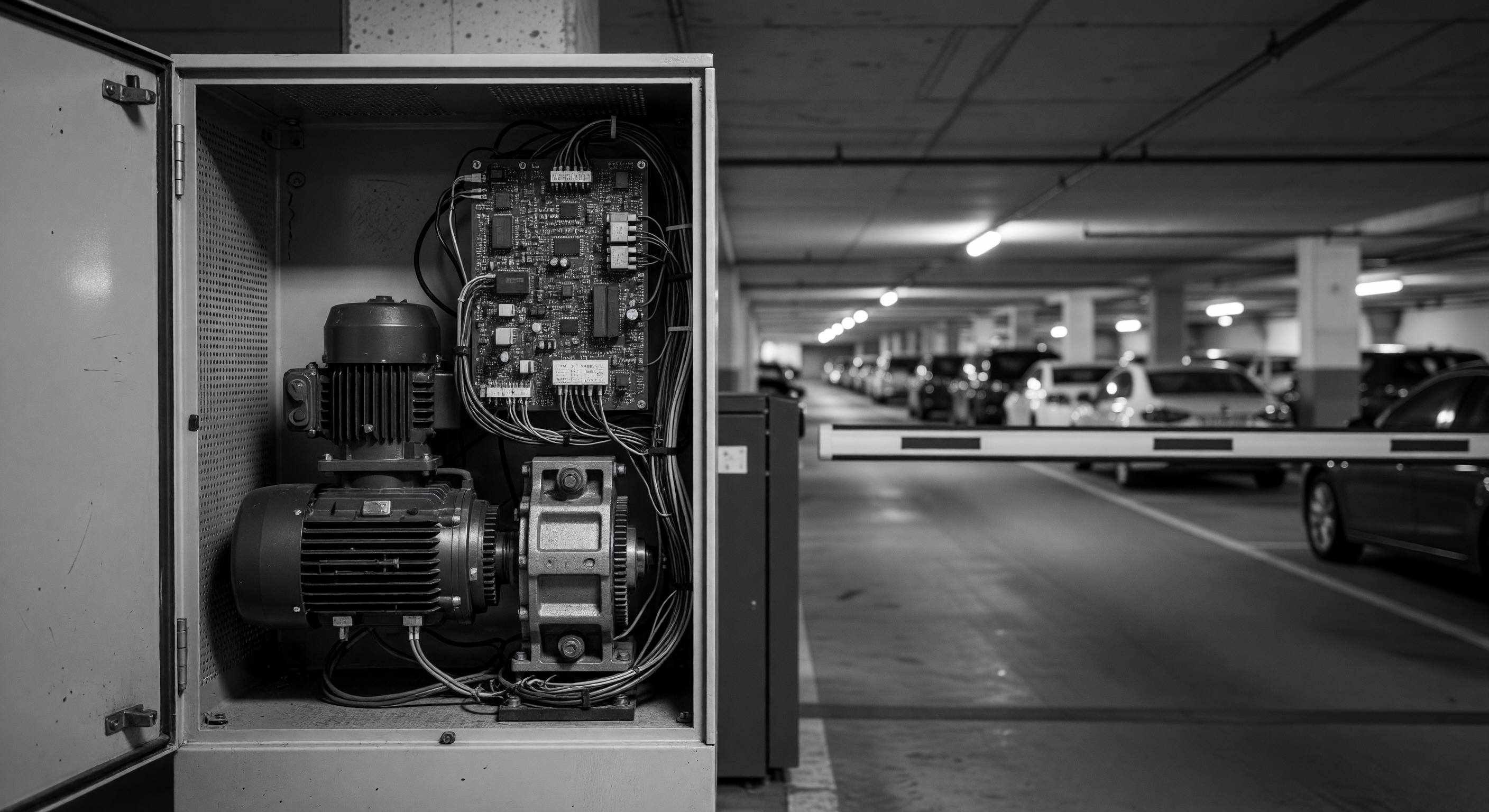
Duty cycle is the single specification most commonly misread on a barrier gate datasheet. A facility that cycles its gate 1,200 times a day cannot use an operator rated for 40 cycles per hour without pushing the motor, gearbox and control board well past their thermal and mechanical design envelopes. Yet this mismatch happens constantly — driven by low bid pricing, inherited specs from a different site, or a vendor quoting the cheapest unit that nominally “fits.”
Manufacturers in North America generally align to the UL 325 framework and the operator class definitions used by the Door & Access Systems Manufacturers Association. Understanding where a facility sits in that framework — and building in headroom — is the difference between a gate that lasts a decade and one that fails inside two years.
The four operator classes
Barrier gate and vehicular gate operators are commonly described in four classes:
- Class I — Residential. Single-family homes, one to four vehicles per day. Not applicable to commercial parking.
- Class II — Commercial/General Access. Small commercial sites, light traffic. Typical cycle counts: under 150 per day.
- Class III — Industrial/Limited Access. Industrial yards, limited-access lots. Typical cycle counts: up to roughly 600 per day with rest periods.
- Class IV — Restricted/High-Security or High-Volume. Airports, transit facilities, high-volume parking structures, toll plazas. Continuous or near-continuous duty.
UL 325 safety requirements apply across all classes. Duty cycle is a separate mechanical and thermal rating that determines whether the operator can sustain the demand without overheating or wearing out prematurely. Guidance on vehicular gate operator classification is published by UL and referenced in ASTM F2200.
Counting cycles honestly
The most common specification mistake is counting “average” traffic. Average daily cycles tell you very little — peak hour load is what kills operators. A suburban office lot that averages 400 cycles a day may see 180 of those concentrated between 7:45 and 9:15 a.m. That’s roughly two cycles per minute sustained for ninety minutes, and it will eat a Class II operator alive.
Steps for a defensible cycle count:
- Pull gate controller logs or loop detector counts for a representative two-week period.
- Identify peak hours (typically morning arrival, evening departure, shift changes).
- Calculate peak-hour cycles per minute, not daily averages.
- Double that figure to create headroom for event days, holidays, construction detours and future expansion.
- Match the resulting cycles-per-hour to manufacturer duty ratings — not marketing class labels.
A Class III operator rated at 40 cycles per hour continuous, for example, can briefly tolerate 60+ cycles per hour but not sustain it. Thermal cut-outs will trip, and recovery time eats into useful uptime.
Where class selection quietly fails
Three patterns show up in failure forensics again and again:
Specifying by price tier rather than load. A facility manager replacing an aging unit often buys “the same or better” without checking whether the original was correctly sized. If the first install was under-specified, the replacement perpetuates the problem.
Shared specs across a portfolio. REITs and management companies sometimes standardize on one operator model across dozens of sites. That works when volumes are similar. It fails badly when a suburban medical office and a downtown transit park-and-ride are forced onto the same SKU.
Ignoring dwell time. Cycle counts assume the gate opens, the vehicle passes, and the gate closes. Tailgating, stopped vehicles, and loops that hold the gate open for 30+ seconds all change the thermal profile. Long dwell cycles with frequent reversals stress motors differently than clean cycles.
Manufacturer ratings vs. field reality
Datasheets from manufacturers such as HUB, FAAC, Magnetic Autocontrol, CAME and others typically publish both a class designation and a raw cycles-per-hour figure. The raw number matters more. Two Class III-rated units from different manufacturers can have very different continuous-duty ratings — 40 cph vs 80 cph is common — and the one that matches the facility’s peak load is the correct choice regardless of badge.
Ambient temperature also affects allowable duty. A unit rated at 80 cph at 20 degrees C may derate significantly at 35 degrees C without a heated or ventilated housing. Manufacturer derating curves are worth requesting in writing before a purchase order goes out.
Frequently Asked Questions
Can I use a Class II operator on a high-volume site if I oversize the motor?
No. Duty cycle class reflects the entire drivetrain — motor, gearbox, bearings, control board, and thermal design. Swapping a bigger motor into a Class II housing does not give you Class III reliability; it usually accelerates gearbox wear.
How much headroom should I build into a duty-cycle spec?
A common rule of thumb is 2x peak-hour load. Facilities anticipating growth or event spikes go to 3x. Undersizing by even 20% at peak reliably produces mid-life failures.
Does duty cycle apply to the arm, or only the operator?
Primarily the operator. Arm materials (aluminum, fiberglass, articulating sections) are selected for lane width, wind load and frangibility. However, high cycle counts combined with heavy arms accelerate bearing wear, so the two specifications are related.
Where can I find published duty-cycle testing standards?
UL 325 covers safety. ASTM F2200 addresses construction. Neither mandates a specific cycles-per-hour test, which is why manufacturer-published endurance test data — MTBF, cycle-to-failure — should be requested directly.