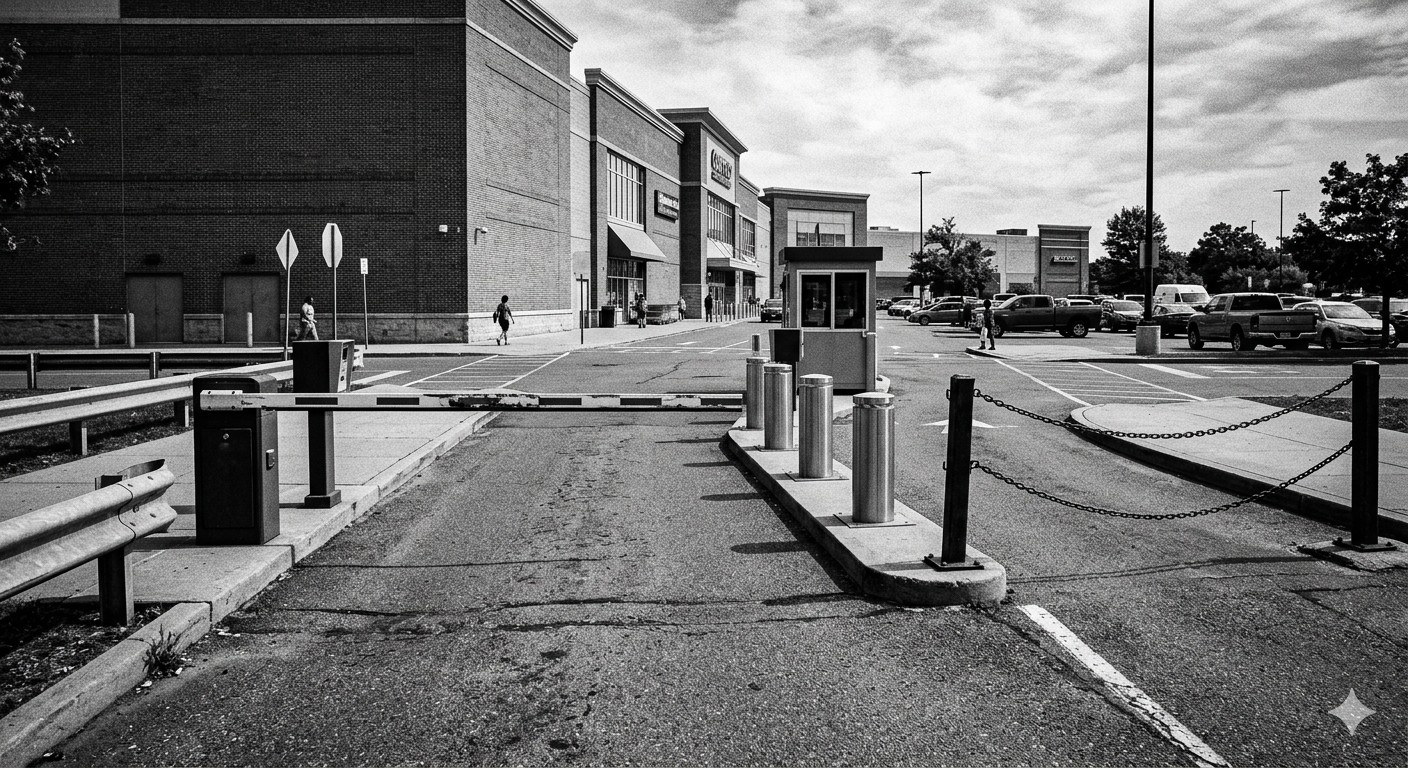
When you need to control vehicle access to a parking lot, three solutions come up in nearly every conversation: barrier gates, bollards, and chain barriers. Each solves a different version of the same problem, and choosing the wrong one wastes money, frustrates users, or leaves your facility exposed.
This comparison breaks down the strengths, limitations, costs, and best applications of each option so you can make an informed decision for your specific situation.
The Three Options at a Glance
| Factor | Barrier Gate | Bollard | Chain Barrier |
|---|---|---|---|
| Primary function | Traffic flow control and access management | Perimeter security and area protection | Low-cost access restriction |
| Vehicle throughput | High (hundreds/hour) | Low (manual) to moderate (automatic) | Very low |
| Security level | Low to moderate (arm is not a physical barrier) | High (crash-rated options available) | Low |
| Cost per access point | $5,000 – $25,000 installed | $1,000 – $8,000 per bollard | $500 – $3,000 installed |
| Automation | Standard | Available but expensive | Rare |
| ADA compliance | Straightforward | Requires careful spacing | Difficult |
| Best for | Garages, commercial lots, revenue control | Storefronts, plazas, high-security perimeters | Private driveways, temporary closures |
Barrier Gates: The Traffic Management Solution
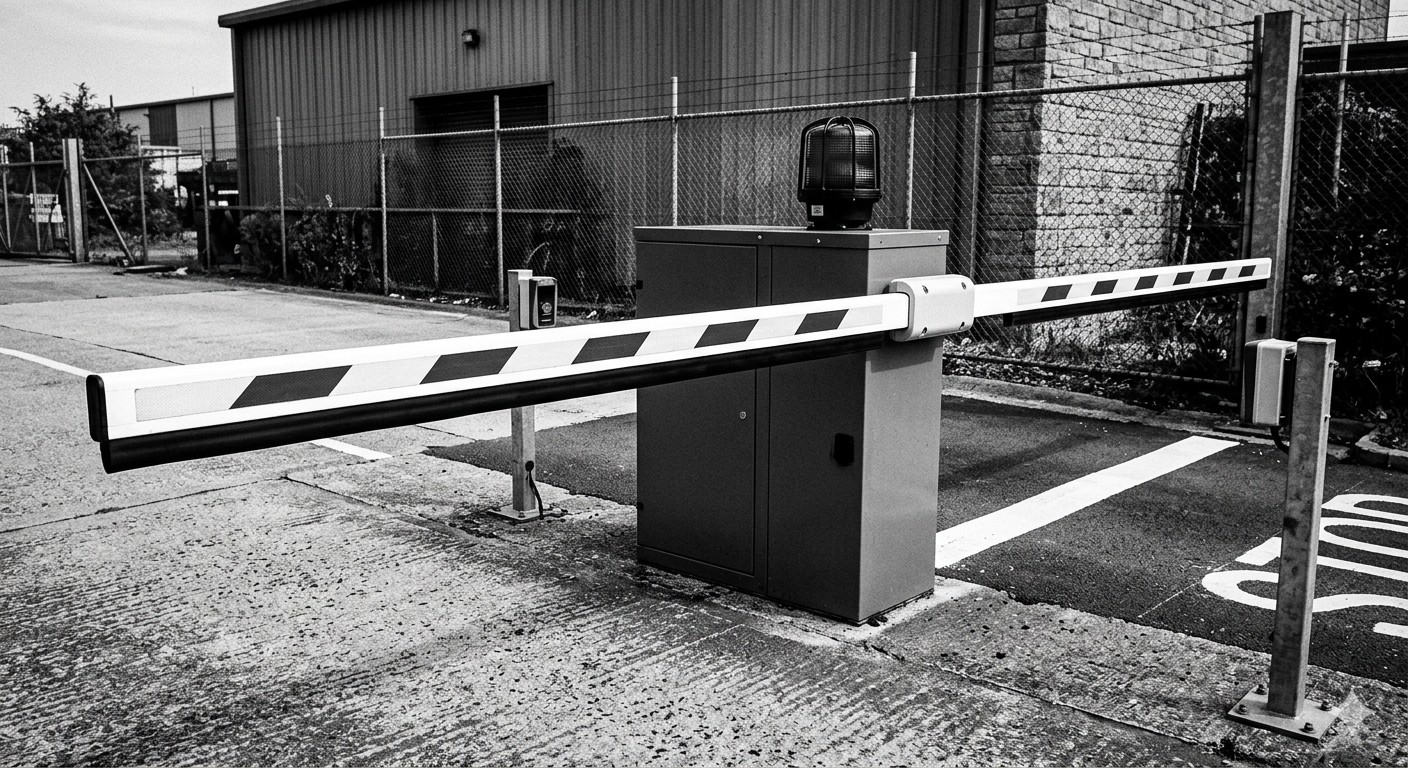
Barrier gates are the standard for any parking facility that needs to manage vehicle flow — counting cars, controlling access, or collecting revenue. The arm swings up to admit a vehicle and lowers behind it.
How They Work
A motorized mechanism inside a housing raises and lowers a horizontal arm, typically 3 to 6 meters long. The gate responds to signals from access control devices: card readers, ticket dispensers, LPR cameras, or remote controls. Loop detectors embedded in the pavement prevent the arm from lowering onto a vehicle.
For a deeper technical explanation, see our guide on how automatic car park barriers work.
Strengths
- High throughput. Modern barrier gates cycle in 1 to 4 seconds, enabling hundreds of transactions per hour. This is unmatched by bollards or chains.
- Integration ready. Barrier gates connect to virtually any parking management system — ticket validators, payment terminals, RFID readers, and license plate recognition cameras.
- Revenue control. When paired with a pay station or validation system, barrier gates enforce payment. This is their core value proposition.
- User familiarity. Drivers universally understand how to interact with a barrier gate. There is almost no learning curve.
Limitations
- Not a physical security barrier. A standard arm will break if a vehicle drives through it. Barrier gates deter and manage — they do not stop a determined intruder. Breakaway arms are designed to fail safely.
- Requires power and connectivity. Barrier gates need electrical supply and, increasingly, network connectivity. Power failures require battery backup or manual intervention.
- Maintenance demands. Motors, springs, limit switches, and control boards all need periodic service. Budget $300 to $1,200 per gate annually.
When to Choose a Barrier Gate
Choose a barrier gate when your primary goal is managing vehicle flow, enforcing paid parking, or controlling access with credentials. Barrier gates are the right answer for commercial parking lots, garages, office campuses, hospitals, airports, and any facility where throughput and integration matter.
Manufacturers like CAME, FAAC, Magnetic Autocontrol, Nice/Hi-Speed, and Parking BOXX all produce commercial-grade barrier gates across a range of specifications and price points. For a comprehensive evaluation framework, see our complete buyer’s guide to barrier gate systems.
Bollards: The Physical Security Solution
Bollards are vertical posts installed in the ground to physically block vehicle access. They range from simple steel pipes set in concrete to sophisticated retractable or crash-rated units.
Types of Bollards
Fixed bollards are permanent posts cemented into the ground. They block vehicle access entirely and are the most common type seen in front of retail stores, pedestrian zones, and government buildings.
Removable bollards can be unlocked and lifted out of a sleeve in the ground. This allows occasional vehicle access — for deliveries, for example — without permanent openings.
Retractable (automatic) bollards lower into the ground on command, controlled by card readers, remote controls, or a central management system. They combine physical security with controlled access.
Crash-rated bollards meet specific impact resistance standards. They are designed and tested to stop a vehicle traveling at a defined speed and weight — typically per ASTM F2656 (formerly DOS SD-STD-02.01) standards. These are used at government buildings, military installations, embassies, and critical infrastructure.
Strengths
- True physical barrier. Unlike a barrier gate arm, a bollard can physically stop a vehicle. Crash-rated bollards stop trucks.
- Compact footprint. Bollards take up very little space. They work in tight urban environments where a barrier gate housing would not fit.
- Low maintenance (fixed type). A fixed steel bollard set in concrete requires essentially zero maintenance.
- Aesthetic flexibility. Bollards come in decorative styles that blend with architecture — stainless steel, cast iron, illuminated, planter-topped.
Limitations
- Low throughput. Even automatic retractable bollards cycle slowly compared to barrier gates. A typical retractable bollard takes 3 to 8 seconds to lower and the same to raise. They are not designed for high-volume traffic.
- High cost for automation. A single retractable bollard can cost $5,000 to $15,000 installed. You need multiple units to secure a standard lane width. The cost per access point adds up quickly.
- Installation complexity. Retractable bollards require deep excavation, drainage provisions, and substantial civil work. Fixed bollards are simpler but still need proper foundations.
- Pedestrian hazard. Bollards at the wrong height or spacing can be tripping hazards, especially for visually impaired pedestrians. Spacing must comply with ADA requirements — generally 36 inches minimum clear passage.
- No revenue control capability. Bollards open and close. They do not process payments, count vehicles, or integrate with parking management software in any meaningful way.
When to Choose Bollards
Choose bollards when physical security is the primary concern — preventing vehicle intrusion into pedestrian areas, protecting building perimeters, or meeting anti-ram requirements. They are also a good fit for controlling occasional access to service areas or pedestrian zones where traffic volume is very low.
Chain Barriers: The Budget Option
Chain barriers stretch a chain or cable across an opening. They range from a simple chain hung between two posts to motorized systems with retractable chains.
Types of Chain Barriers
Manual chain barriers are exactly what they sound like: a chain clipped between two posts. Someone unclips the chain to allow access and re-clips it after. They cost almost nothing.
Automatic chain barriers use a motorized post that winds or unwinds a chain. They can be triggered by remote controls, card readers, or timers. These are more common in Europe than in North America.
Strengths
- Low cost. A manual chain barrier can be installed for a few hundred dollars. Even motorized versions are relatively inexpensive.
- Simple installation. Two posts and a chain. No deep excavation, no complex electrical work for the manual version.
- Visual deterrent. A chain across an opening signals “do not enter” clearly enough for most situations.
- Flexibility. Easy to add, remove, or relocate as needs change.
Limitations
- Minimal security. A chain will not stop any vehicle that wants to get through. It is a visual and psychological deterrent only.
- No automation at scale. Motorized chain barriers exist but are slow and unreliable compared to barrier gates.
- Liability concerns. Chains at bumper height can be difficult to see, especially at night. If a motorcycle or cyclist hits an unmarked chain, the liability exposure is significant.
- No integration. Manual chains cannot connect to access control or parking management systems.
- ADA issues. A chain across a path is problematic for wheelchair users and creates tripping hazards for visually impaired pedestrians.
- Unprofessional appearance. For commercial facilities trying to project a quality image, chains look temporary and improvised.
When to Choose a Chain Barrier
Chain barriers make sense for temporary closures, private driveways, seasonal access points, and very low-traffic situations where cost is the dominant concern. They are not appropriate for commercial parking operations, public-facing facilities, or any application requiring security, automation, or integration.
Decision Framework: Matching the Solution to the Need
By Primary Goal
| Your Primary Goal | Best Option | Why |
|---|---|---|
| Revenue control / paid parking | Barrier gate | Only option that integrates with payment systems |
| High-volume access control | Barrier gate | Throughput capacity is unmatched |
| Anti-vehicle perimeter security | Crash-rated bollards | Physical stopping power |
| Pedestrian zone protection | Fixed bollards | Permanent, low-maintenance |
| Occasional access with high security | Retractable bollards | Physical barrier with remote operation |
| Temporary or seasonal closure | Chain barrier | Low cost, easy to install/remove |
| Private driveway control | Chain or bollard | Depends on budget and security need |
By Facility Type
Commercial parking lots and garages: Barrier gates. Revenue control and throughput are the priorities. The National Parking Association and IPMI both publish guidance on parking facility design that consistently positions barrier gates as the standard for managed parking.
Retail storefronts and pedestrian plazas: Fixed bollards. Protect pedestrians from vehicle intrusion while maintaining foot traffic flow.
Government and military facilities: Crash-rated bollards, often combined with barrier gates. The bollards provide physical security; the gates manage credentialed traffic flow.
Residential communities: Barrier gates for main entrances with meaningful traffic volume. Bollards or chains for secondary access points and service entrances.
Construction sites and temporary lots: Chain barriers for short-term use. Upgrade to barrier gates if the site will operate for more than a few months.
Combining Solutions
In practice, many facilities use more than one type of barrier. A well-designed parking facility might deploy:
- Barrier gates at all vehicle entry and exit lanes for access control and revenue management
- Fixed bollards along pedestrian walkways adjacent to drive aisles
- Retractable bollards at a service entrance used by delivery trucks once or twice a day
- Chain barriers across overflow lot entrances that are only open during events
This layered approach matches each barrier type to the specific need at each location within the facility. It is more cost-effective than trying to use a single solution everywhere.
Cost Comparison: Total Installed Cost Per Access Point
| Solution | Equipment Cost | Installation Cost | Annual Maintenance | 10-Year Total |
|---|---|---|---|---|
| Barrier gate (mid-range) | $4,000 – $8,000 | $2,000 – $5,000 | $500 – $1,000 | $13,000 – $23,000 |
| Retractable bollard (per unit) | $3,000 – $8,000 | $3,000 – $7,000 | $300 – $800 | $9,000 – $23,000 |
| Retractable bollards (3 per lane) | $9,000 – $24,000 | $9,000 – $21,000 | $900 – $2,400 | $27,000 – $69,000 |
| Fixed bollards (3 per lane) | $900 – $3,000 | $1,500 – $4,000 | ~$0 | $2,400 – $7,000 |
| Chain barrier (motorized) | $1,500 – $3,000 | $500 – $1,500 | $100 – $300 | $3,000 – $7,500 |
| Chain barrier (manual) | $100 – $500 | $200 – $500 | ~$0 | $300 – $1,000 |
Note: Retractable bollards become very expensive on a per-lane basis because you need multiple units to cover a standard lane width. This is why barrier gates dominate in parking applications — one gate covers the entire lane.
For a deeper dive into barrier gate pricing specifically, see our commercial parking lot gate guide.
Key Takeaways
- Barrier gates are the clear choice for parking management, revenue control, and any application requiring high throughput and system integration. They manage traffic; they do not stop it.
- Bollards are the choice when physical vehicle stopping power is required — perimeter security, pedestrian protection, anti-ram. Retractable bollards offer controlled access but at high cost and low throughput.
- Chain barriers are a budget option for temporary, low-traffic, or private applications. They are not appropriate for commercial or public-facing facilities.
- Most facilities benefit from a combination of barrier types, with each type matched to the specific requirements of each access point.
- The decision starts with your primary goal: Is it traffic flow, physical security, or just a visual deterrent? That answer narrows the field immediately.