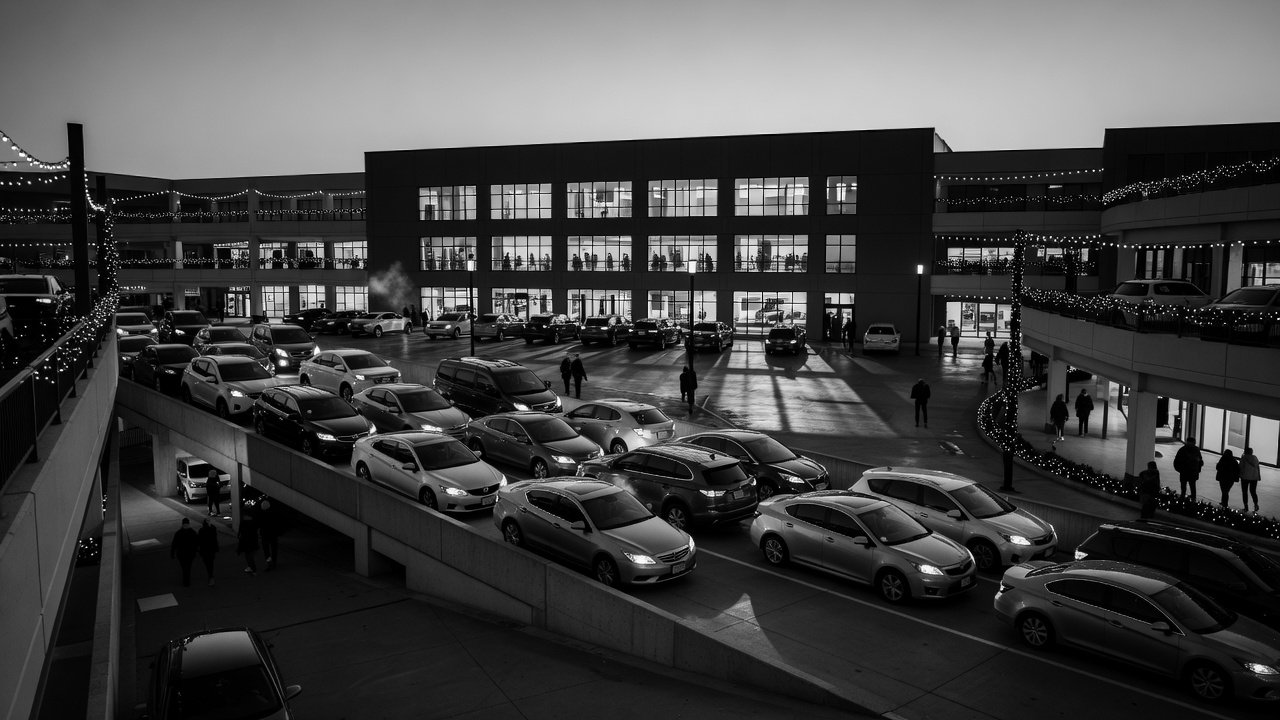
A gated entry designed for an ordinary Tuesday will behave differently on the Friday after Thanksgiving. Arrival rates rise, drivers are unfamiliar with the facility, and a single slow transaction ripples back to the street. When the queue reaches the public road, the problem is no longer just a parking one: it blocks traffic, draws attention from the city, and sends shoppers elsewhere.
The retail calendar gives operators advance notice. The National Retail Federation forecast for the 2025 holiday season put November and December sales growth between 3.7 and 4.2 percent, with total spending expected to pass $1 trillion for the first time, according to its published press release. Demand is not shrinking, and the weeks around Thanksgiving remain the pressure point for properties that serve shoppers.
Know Your Lane Capacity Before the Peak
Capacity is set by the slowest step in the transaction, not by the gate hardware alone. A barrier operator that raises its arm in a couple of seconds is irrelevant if each driver takes thirty seconds to pull a ticket, find a payment card, or ask a question.
Measure what your lanes actually do on a busy day in October or early November:
- Time from vehicle arrival to arm fully raised, across a sample of transactions.
- Time from arm clear to arm closed, which governs how soon the next vehicle can proceed.
- How many vehicles can queue on-site before the line spills onto a public street.
That last number, the storage length, is the one that decides your holiday plan. If the lanes can hold forty vehicles and demand will bring sixty in a peak hour, you need to either speed up the transaction or move the queue point.
Reduce the Time Per Transaction
Remove the slow steps
Ticket-and-pay-at-exit designs concentrate delay at the exit, where a shopper with a full trunk is rummaging for a card. Credential-based and plate-recognition entries remove the stop altogether. If a retrofit is not on the table, smaller changes help: pre-paid validations for event days, a clear single instruction on signage, and an attendant at the lane who can wave through known problems.
Match lane direction to demand
Many garages can reverse a lane. During a morning arrival surge, converting an exit lane to an entry lane relieves the entry side, while the reverse applies after closing. Reversible lanes need working equipment in both directions, clear signage, and a documented procedure for the changeover so it does not strand a vehicle mid-lane.
Keep ticket stock and consumables full
A ticket dispenser that runs out of paper at midday on the busiest day is a preventable failure. Stock rolls, receipt paper, and cleaning supplies before the weekend, and check ticket stock levels as part of the opening routine.
Control the Queue Outside the Gate
The cheapest capacity is often outside the equipment. A few measures keep the line orderly:
- Overflow routing. Direct arrivals to a second entrance or an open surface lot when the primary garage reaches a set occupancy.
- Occupancy signs. Real-time counts at the entrance tell drivers the garage is full before they commit to the queue.
- Staging and cones. Define where the queue forms so it does not block a cross street or a fire lane.
- Coordination with local authorities. If a backup is likely to affect public roads, notify the city or traffic officers ahead of time. A prior conversation is easier than an enforcement call.
Staffing and Support
Equipment on a peak day needs people close to it. Place attendants or technicians where they can reach the busiest lanes quickly, and give them authority to lift an arm and release a stuck transaction. Make sure the remote support line is staffed and that staff know who to call, and in what order, for gate faults, payment faults, and network faults.
Cross-train the seasonal team on the basic fixes: clearing a ticket jam, resetting a lane, relocating a vehicle off a detector loop. Written one-page procedures at each lane beat a binder in an office.
Prepare the Equipment
A pre-holiday service visit is worth scheduling in October. Ask the service provider to cover:
- Arm balance, limit settings, and cycle behavior in each lane.
- Detector loops and photo beams, since a false detection holds a lane.
- Safety devices, because a lane that stops frequently under heavy traffic is usually responding to a sensor.
- Network connectivity to payment and management software, including a test of what happens when the connection drops.
- Backup power state, so a brief outage does not take down the entry during peak hours.
Where a freeze on non-essential changes makes sense, apply it. Software updates, configuration edits, and rate-table changes in the weeks before and during the peak add risk with no benefit to throughput.
Plan the Fallback
Even a well-prepared site can lose a lane or a payment link. Decide in advance what happens next. A common approach is an open-gate or attendant-lift mode that lets vehicles enter without payment, with reconciliation later through plate capture or exit fees. Consider the revenue cost against the traffic cost: a few hours of free entry is often cheaper than a line on a public road, but the decision belongs to the operator, and it is better made in October than at 1 p.m. on Black Friday.
Write down the trigger, who can authorize it, and how it will be reversed. Include a way to track what was let through so the lost revenue can be estimated afterward.
Review After the Season
Capture what happened: peak hourly arrivals, longest queue, faults by lane, and time to resolve each. Compare against what you assumed. The result is the most credible case for next year’s staffing, equipment upgrades, or lane changes, and it replaces guesswork with your own site’s numbers.