A UL 325 label on the operator does not make a parking gate compliant. That single misunderstanding drives most of the compliance gaps auditors and technicians find at commercial parking facilities, and it survives because the label looks like proof. It is not. The 7th Edition of ANSI/CAN/UL 325 treats compliance as a property of the installed system, the site classification, and the ongoing maintenance program, not the factory certification of one component. Facility managers who inherit an operating gate rarely re-check any of that, and the gaps compound quietly until an entrapment incident or an insurer’s questionnaire forces the issue.
Here is what the standard actually requires, and where facilities keep falling short.
The 7th Edition is the baseline, and it has moved since 2018
Every automated vehicular gate operator manufactured on or after August 1, 2018 must meet the 7th Edition of UL 325. That edition is not new, but its requirements are still widely misapplied. It clarified ambiguous 6th Edition wording, prohibited tampering with or bypassing monitoring features, and formalized the four-class system that determines which entrapment protections your site needs.
The standard has continued to evolve. A March 2024 Standards Update Notice added provisions for bifold gates and revised the injury-warning language, with those changes taking effect in March 2025. The standard is now published as ANSI/CAN/UL 325, harmonizing the requirements across the United States and Canada. If your compliance documentation still references a pre-2018 edition or a US-only UL 325 designation, it is out of date.
UL 325 is a voluntary standard, meaning it does not carry the force of law on its own. That reassures the wrong people. Customers, insurers, and courts increasingly treat adherence as the expected standard of care, so a facility that installs and operates access-control gates is expected to know and comply on every gate, voluntary or not.
Mistake 1: Misclassifying the gate
UL 325 sorts gate operators into four usage classes, and the class dictates the required entrapment protection. Getting this wrong invalidates everything downstream.
Class II is where most parking facilities belong
- Class I covers single-family residential use with no public access.
- Class II covers commercial and general-access installations, including parking facilities, community gates serving multiple residences, and any location where the general public may be present.
- Class III covers industrial and limited-access sites restricted to trained, authorized personnel.
- Class IV covers restricted-access, guarded installations with security personnel monitoring the gate.
A commercial or municipal parking structure open to the public is a Class II environment, full stop. Technicians routinely find gates classified and equipped as Class I because that is how they arrived or how a prior contractor set them up. A Class I configuration in a Class II setting is non-compliant on its face, regardless of how well the hardware works, because the required protections for public exposure were never installed.
Mistake 2: Treating one sensor as enough
The 7th Edition requires at least two independent means of entrapment protection for each potential entrapment zone, in each direction of travel. The two means must be different types. You cannot satisfy the requirement with two photo eyes.
UL 325 defines the available types precisely:
- Type A — inherent entrapment protection built into the operator (the reversing system).
- Type B1 — a non-contact sensor, typically a photoelectric eye.
- Type B2 — a contact sensor, typically a safety edge.
- Type C — inherent force limiting or an adjustable clutch, permitted only on swing gates and barrier arms.
- Type D — a constant-pressure actuating device that requires the operator to hold the control for the gate to move.
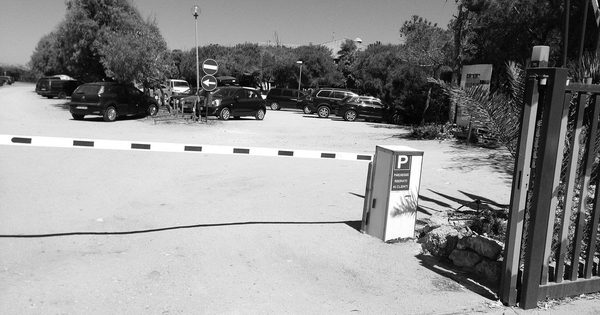
For a typical parking barrier arm, that usually means the operator’s inherent Type A protection paired with a monitored external device such as a photo eye. Barrier arms may also rely on Type C inherent force limiting, which is one of the few placements where Type C is allowed. The failure pattern is a gate running on inherent protection alone, with no monitored secondary device, or with a single device covering only one direction of travel.
Mistake 3: Running with monitoring defeated
Gate operators manufactured after January 11, 2016 must continuously monitor their connected external entrapment sensors. If a photo eye or edge sensor is disconnected, misaligned, dirty enough to fail, or otherwise not confirmed operational, the operator is designed to refuse to cycle the gate. That refusal is the safety feature working as intended.
Facilities frequently defeat it. When a monitored sensor starts nuisance-tripping, the field response is often to bypass it so the gate keeps moving traffic. A gate that continues to operate with an active sensor alarm is non-compliant and carries direct liability, because the person who bypassed the sensor removed the exact protection the standard requires. The 7th Edition explicitly prohibits tampering with or bypassing monitoring for this reason. If your operator runs while a sensor fault is showing, that is not a workaround, it is a documented compliance failure.
Mistake 4: Assuming compliance is permanent
A gate that was fully compliant at installation drifts out of compliance without maintenance. Photo eyes collect dirt and fall out of alignment, so the beam no longer covers the full travel path. Edge sensors wear. Reversing thresholds move as mechanical components age. None of this shows up until someone tests it, and most facilities never schedule the test. Compliance is a maintained state, not a one-time certification, and the maintenance log is part of the evidence you will want if an incident is ever reviewed.
Mistake 5: Confusing UL 325 with ASTM F2200
UL 325 governs the operator. It does not govern the gate panel or barrier arm itself. ASTM F2200 is the companion standard covering the construction and installation of the gate, addressing pinch points, harmful protrusions, positive stops that keep the gate within its design travel, and hardware that prevents a detached gate from falling. The two are written to work together under a harmony principle. A facility can pass on the operator and still fail on the gate structure, so a compliance review that only checks the operator is incomplete. DASMA and the named standards bodies, UL and ASTM, publish the reference material for both.
A compliance checklist for your next site walk
Walk each gate against this before you file it as compliant:
- Confirm the operator meets the 7th Edition (ANSI/CAN/UL 325), manufactured on or after August 1, 2018, with documentation that matches the current edition.
- Verify the usage class matches actual public exposure. Most public parking gates are Class II, not Class I.
- Confirm two different types of entrapment protection cover each entrapment zone in each direction of travel.
- Confirm every external sensor is monitored, aligned across the full travel path, clean, and free of active faults, with nothing bypassed.
- Verify ASTM F2200 conditions on the gate or arm itself: positive stops, no pinch points or protrusions, secure mounting.
- Put every gate on a documented preventive-maintenance and test schedule, and keep the records.
If any gate fails a line above, it is non-compliant today, no matter what the operator label says.